Types of Cyberattacks: The Complete Guide (2026)
The types of cyberattacks fall into a handful of categories — malware, social engineering, network, injection, credential, supply-chain, and advanced multi-stage campaigns. This taxonomy guide breaks down each, with a deep dive and the defenses that stop it.

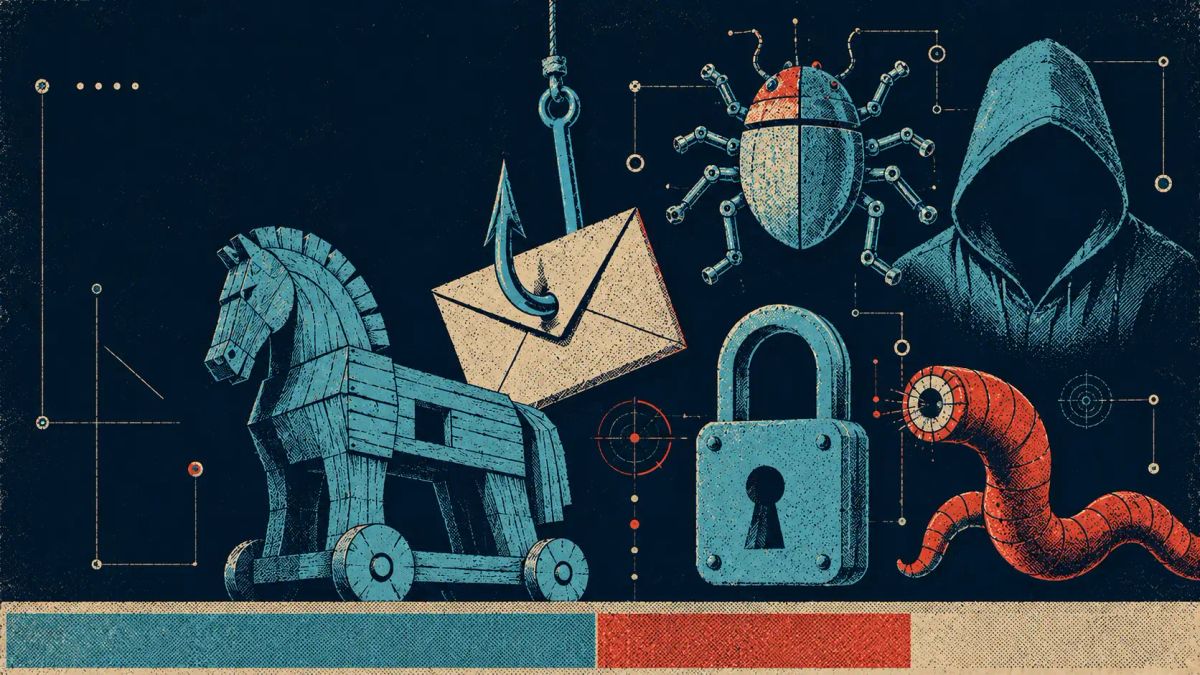
The types of cyberattacks are many, but they are not random. Almost every intrusion — however sophisticated — belongs to one of a handful of recognizable categories, each with its own method of entry, its own target, and its own set of defenses. Learn the categories and you gain the one thing defenders need most: a mental map that turns a chaotic threat landscape into a set of known, manageable risks.
This is the taxonomy reference. For the underlying definition, motives, and real-world examples of what a cyberattack actually is, see our companion explainer; this guide focuses on classifying the attacks themselves and pointing you to a deep dive on each.
What Are the Types of Cyberattacks?
The types of cyberattacks fall into a handful of categories defined by the attack surface they target: malware aimed at systems, social engineering aimed at people, network attacks aimed at availability, injection attacks aimed at applications, credential attacks aimed at identity, and advanced multi-stage campaigns that chain several of these together. Every category has a known method of operation — and a known way to defend against it.
There is no single official taxonomy of cyberattacks, but security professionals group them in two complementary ways. By method or vector describes how the attack is carried out — the grouping this guide follows. By objective describes what the attacker wants: to steal data, extort money, disrupt operations, conduct espionage, or gain a foothold for later. Most real incidents combine several techniques, so treat the categories below as building blocks attackers chain together, not isolated boxes. The surface map shows where each one lands.
● THE CYBERATTACK SURFACE MAP Every attack type hits one of five surfaces — and all of them aim at the same prize. |
THE HUMAN LAYER Phishing, spear phishing, BEC, vishing, social engineering, deepfakes. |
CREDENTIALS & IDENTITY Brute force, password spraying, credential stuffing, MFA bypass, account takeover. |
THE NETWORK DDoS, denial-of-service, man-in-the-middle, DNS spoofing, session hijacking. |
WEB & APPLICATIONS SQL injection, cross-site scripting (XSS), cross-site request forgery (CSRF). |
ENDPOINTS & SOFTWARE SUPPLY Malware, ransomware, zero-day exploits, exploit chains, supply-chain compromise. |
| ↓ |
THE OBJECTIVE Steal data, extort money, disrupt operations, conduct espionage, or plant a foothold for later. |
Framework references: MITRE ATT&CK; NIST; CISA; OWASP. |
Malware Attacks
Malware — malicious software — is the broadest category of cyberattack: any program written to harm a system, steal information, or hand an attacker control. It usually arrives through malicious attachments, compromised websites, infected downloads, or removable media. The major families are viruses and worms (self-replicating code), trojans (malware disguised as legitimate software), spyware and keyloggers (silent activity recorders), and rootkits (deep, persistent stealth).
Ransomware deserves its own line as the most financially damaging malware in operation today. Attackers encrypt an organization's data and demand payment — increasingly while also threatening to leak stolen files. To see how these operations run as a business, read how ransomware gangs operate.
Social Engineering and Phishing Attacks
Where malware attacks the machine, social engineering attacks the person — manipulating trust, fear, urgency, or curiosity to trick someone into revealing information or granting access. Because it bypasses technical controls entirely, it remains one of the most effective categories. Phishing is its most widespread form, with variants including spear phishing (targeted at one person), whaling (aimed at executives), smishing and vishing (delivered by text or voice), and business email compromise, which impersonates an executive or vendor to authorize fraudulent payments.
Denial-of-Service and Network Attacks
Some attacks target availability — the ability to use a service at all. A denial-of-service (DoS) attack floods a system with more traffic than it can handle; a distributed denial-of-service (DDoS) attack amplifies that flood using a botnet of thousands of compromised devices, making it far harder to block. Other network-layer attacks intercept rather than block: in a man-in-the-middle attack the adversary secretly sits between two parties to eavesdrop or alter traffic, using techniques like DNS spoofing and session hijacking.
Web Application and Injection Attacks
Web applications are perpetually exposed by design. Injection attacks exploit apps that fail to validate user input, letting an attacker insert malicious commands. The classic three, all catalogued in the OWASP Top 10, are SQL injection (malicious database queries that read, alter, or delete data), cross-site scripting (XSS) (scripts that run in other users' browsers), and cross-site request forgery (CSRF) (tricking a logged-in browser into unwanted actions). They are largely preventable through secure coding, input validation, and web application firewalls — yet remain common because one overlooked field can expose an entire database.
Password and Credential Attacks
Stolen and weak credentials are now among the leading causes of breaches: rather than break in, attackers simply log in. The category spans brute force (systematically trying combinations), password spraying (a few common passwords across many accounts to dodge lockouts), and credential stuffing (reusing username-password pairs leaked elsewhere). Success usually means account takeover. Multi-factor authentication is the single most effective defense — though attackers have developed MFA bypass techniques, including adversary-in-the-middle (AiTM) phishing, in response.
Supply-Chain, Zero-Day, and Insider Attacks
Three categories exploit trust rather than a direct flaw. A supply-chain attack compromises a trusted vendor or software component to reach many victims at once — one poisoned update can cascade to thousands of downstream organizations. A zero-day exploits a vulnerability the vendor does not yet know about, so no patch exists when the attack lands. And an insider threat — a malicious or negligent employee — already sits inside the trust boundary, which is what makes it so hard to detect.
Advanced, Multi-Stage, and AI-Enabled Attacks
The most serious cyberattacks are not single events but extended campaigns. An advanced persistent threat (APT) is a prolonged, targeted intrusion — usually by a well-resourced group such as a nation-state — that aims to remain undetected for months. These campaigns rely on a sequence of techniques once inside: privilege escalation raises access from an ordinary account to an admin one, lateral movement spreads it across the network, and attackers stitch multiple flaws together in an exploit chain to defeat layered defenses.
Artificial intelligence is now a force multiplier across all of these. AI generates flawless phishing at scale, writes and adapts malicious code faster than before, and probes for weaknesses automatically. Its most visible new product is the deepfake — synthetic audio or video used in fraud and social engineering. AI does not invent new categories so much as make existing ones cheaper, faster, and more convincing, as our guide to how AI is used in cyberattacks explains.
The Anatomy of a Modern Cyberattack
Although types differ, serious intrusions follow a recognizable lifecycle. An attacker runs reconnaissance to study the target, gains initial access (often via phishing or an exploited vulnerability), establishes persistence, escalates privileges, moves laterally, and finally acts on the objective — stealing data, deploying ransomware, or causing disruption. This sequence is the basis of the Cyber Kill Chain and MITRE ATT&CK. Its practical value: an attack can be detected and broken at any stage — the earlier, the better.
How to Defend Against Cyberattacks
No single tool stops every type. Effective defense is layered, so that if one control fails another stands behind it. The core practices, echoed in CISA's guidance and the NIST Cybersecurity Framework, are:
- Patch promptly. Keep operating systems and software current to close known vulnerabilities before attackers reach them.
- Enforce multi-factor authentication. Require MFA — ideally phishing-resistant methods — on every account that supports it.
- Train people continuously. Regular awareness training cuts the success rate of phishing and social engineering.
- Segment networks. Limit how far an attacker can move laterally once inside.
- Back up data. Maintain tested, offline backups so ransomware cannot hold the organization hostage.
- Monitor and respond. Detect suspicious activity early and keep an incident-response plan ready to contain it.
For a broader view of today's threat environment, see our overviews of the most common cybersecurity threats for organizations in 2026 and how to understand and defend against modern cyber risks.
Frequently Asked Questions
What is the most common type of cyberattack?
Malware and phishing are consistently the most common. Phishing is especially prevalent because it is cheap, scalable, and targets human judgment rather than technical defenses.
What are the main categories of cyberattacks?
Malware, social engineering and phishing, denial-of-service and network attacks, web application and injection attacks, password and credential attacks, and advanced multi-stage campaigns such as APTs.
What is the difference between a cyberattack and a data breach?
A cyberattack is the action an attacker takes to compromise a system. A data breach is one possible outcome — the exposure or theft of sensitive information. Not every cyberattack results in a breach.
Can cyberattacks be prevented?
No defense is perfect, but the large majority of attacks can be prevented or contained with layered controls: prompt patching, MFA, awareness training, network segmentation, reliable backups, and continuous monitoring.