What Is Lateral Movement in Cyberattacks? Techniques & Defense
Lateral movement is how attackers turn a single foothold into a company-wide breach — hopping system to system toward the crown jewels. A defender's guide to the techniques, detection signals, and controls that stop the spread.

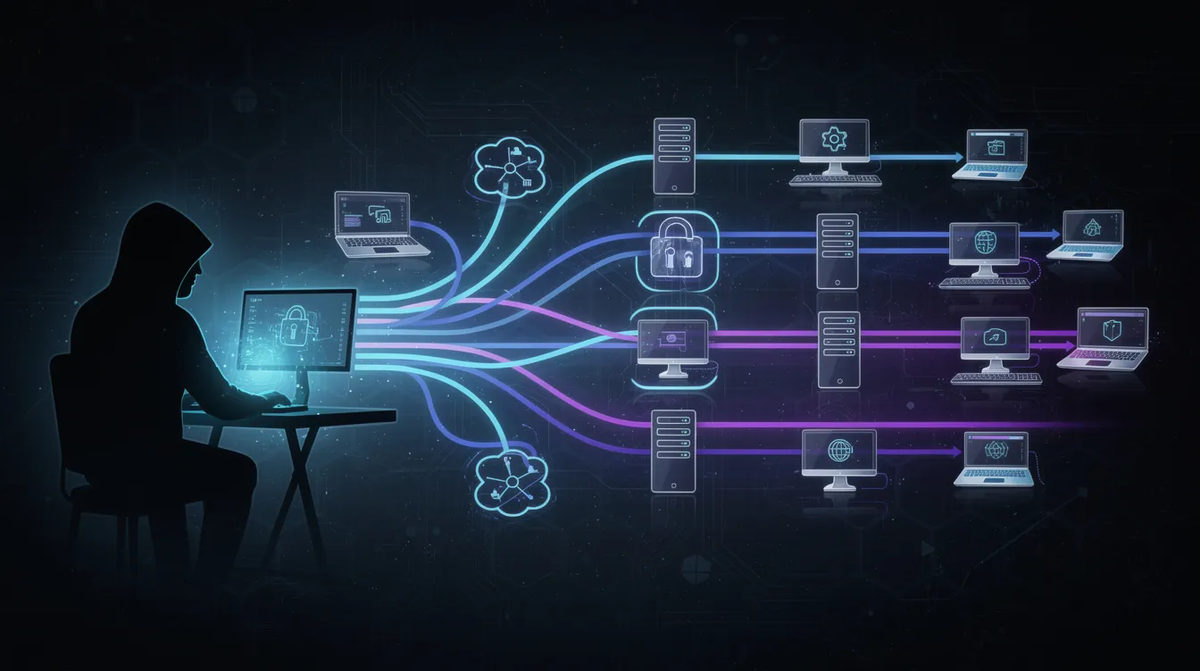
Most people picture a cyberattack as a single break-in: one door forced, one system robbed. Real intrusions almost never work that way. The initial victim — a phishing-clicked laptop, an exposed server — is rarely where the valuable data lives. To reach it, an attacker has to travel, quietly hopping from the first compromised machine to the next until they reach the systems that matter. That traversal is called lateral movement, and it is often the difference between a contained incident and a company-wide disaster.
Lateral movement is the set of techniques attackers use to progressively move through a compromised network after gaining an initial foothold, hopping from system to system to expand access and reach high-value assets. It typically follows initial access and privilege escalation, and precedes the attacker's final objective — data theft, ransomware, or long-term espionage. In the MITRE ATT&CK framework it is a formal tactic, TA0008.
Where Lateral Movement Fits in an Attack
An intrusion is a sequence, not a single event. The attacker first gains initial access — through phishing, a stolen password, or an exploited vulnerability — landing on one machine that is usually of little value on its own. From there they escalate privileges to gain more control, then move laterally to find and reach the systems that actually hold the crown jewels: domain controllers, databases, backup servers, source-code repositories.
This is the phase where a minor breach becomes a major one. A single infected workstation is an annoyance; the same attacker with domain-wide control is an existential threat. Lateral movement is the connective tissue in between, and it is exactly the stage that the patient, well-resourced operators behind advanced persistent threats have refined into an art — dwelling inside networks for weeks or months while they expand their reach.
● HOW LATERAL MOVEMENT SPREADS One compromised laptop is rarely the target. It is the on-ramp to everything else. |
FOOTHOLD — INITIAL ACCESS A phishing email lands on one employee workstation. The attacker now has a single low-value beachhead. |
| ↓ |
PIVOT 1 — HARVEST & HOP Credentials are dumped from memory and replayed with pass-the-hash to reach a nearby file server over SMB. |
| ↓ |
PIVOT 2 — ESCALATE Admin credentials found on that server are reused over RDP and WMI, spreading to more hosts and gaining higher privilege. |
| ↓ |
CROWN JEWELS — DOMAIN CONTROLLER The attacker seizes Active Directory and now controls every account — enough to deploy ransomware or exfiltrate data domain-wide. |
Model: MITRE ATT&CK Lateral Movement (TA0008); a typical credential-driven intrusion path. |
Common Lateral Movement Techniques
What makes lateral movement so hard to catch is that most of it uses legitimate tools and credentials rather than malware. Once an attacker holds a valid account, moving through the network can look almost identical to normal administration. The recurring techniques fall into a few families:
- Credential theft and reuse. Attackers harvest passwords, hashes, and tickets from a compromised machine's memory (using tools such as Mimikatz) and replay them. Pass-the-hash and pass-the-ticket let them authenticate as a user without ever cracking the plaintext password.
- Remote services. Built-in remote-access protocols — RDP, SMB, SSH, and WinRM — are ideal for hopping between hosts because they are expected to carry admin traffic and rarely raise alarms on their own.
- Living off the land. Rather than dropping detectable malware, attackers abuse native administration tools. PsExec, WMI, and PowerShell Remoting can execute commands on remote systems using stolen credentials, blending into routine IT activity.
- Internal reconnaissance. Between hops, attackers map the network — enumerating accounts, shares, and trust relationships — to identify the shortest path to the assets they want.
Because these methods lean on valid credentials and trusted protocols, the defensive problem is less about blocking a known-bad file and more about spotting a legitimate tool being used by the wrong person, at the wrong time, in the wrong direction.
Why Lateral Movement Is So Dangerous
Lateral movement is what lets a small compromise scale into a catastrophic one. It is the mechanism behind nearly every large ransomware incident: operators do not encrypt one laptop and demand a ransom — they move laterally until they control the domain, then detonate ransomware across hundreds or thousands of machines at once for maximum leverage. The same traversal enables data theft at scale, letting attackers reach and quietly exfiltrate databases long before anyone notices.
It also buys the attacker time and stealth. Every additional system they control is another place to hide, another set of credentials to fall back on, and another foothold that survives the cleanup of the original entry point. An organization that evicts the attacker from the first machine but misses the lateral spread has not solved the problem — it has merely lost sight of it.
Detecting Lateral Movement
Detection hinges on watching the internal network, not just the perimeter. Because lateral movement happens between internal systems, the signal lives in east-west traffic — machine-to-machine communication inside the network — which many organizations historically monitored far less closely than traffic crossing the boundary. Practical detection focuses on a few things:
- Anomalous authentication. A user account logging into systems it has never touched, at odd hours, or from an unusual host is a classic tell — especially administrative accounts appearing on ordinary workstations.
- Unusual internal connections. Network detection and response (NDR) tools baseline normal east-west patterns and flag deviations, such as a workstation suddenly opening SMB or RDP sessions to dozens of peers.
- Endpoint telemetry. EDR platforms catch the tools of the trade — credential-dumping, PsExec execution, suspicious PowerShell — on the hosts themselves.
- Deception. Honeypots and honey credentials that no legitimate user should ever touch turn a single access attempt into a high-confidence alarm.
How to Prevent Lateral Movement
You cannot always stop the initial breach, but you can make the network hostile to movement so that one compromised host does not become all of them. The core defenses reinforce each other:
- Segment the network. Network segmentation and microsegmentation carve the environment into zones so that a foothold in one does not grant free passage to the rest. This is the single most effective structural control against lateral spread.
- Adopt zero trust. A zero-trust architecture assumes no user or device is trusted by default and verifies every access request, denying the implicit east-west trust attackers rely on.
- Enforce least privilege. Give every account and service only the access it genuinely needs, so stolen credentials open fewer doors. Pair this with tiered administration that keeps high-privilege accounts off everyday workstations.
- Harden credentials. Strong, unique local admin passwords (for example via Microsoft LAPS), multi-factor authentication, and prompt patching shrink the credential-reuse paths attackers depend on.
- Deploy EDR and NDR. Endpoint and network detection give you the visibility to catch movement in progress and respond before it reaches the crown jewels.
Frequently Asked Questions
What is lateral movement in a cyberattack?
It is the set of techniques attackers use to move through a network after an initial compromise, hopping from system to system to expand access and reach high-value targets such as domain controllers and databases. It sits between gaining a foothold and achieving the final objective.
What is east-west traffic?
East-west traffic is communication between systems inside the same network (server to server, workstation to server), as opposed to north-south traffic that crosses the network perimeter. Lateral movement shows up in east-west traffic, which is why monitoring it is central to detection.
How do you stop lateral movement?
The most effective controls are network segmentation and microsegmentation, a zero-trust architecture, least-privilege access with tiered administration, hardened and unique credentials with MFA, and EDR/NDR tooling to detect movement that does occur. No single measure is sufficient; they work as layers.