What Is a Deepfake? How They Work, the Risks, and Detection
A deepfake is AI-generated video, audio, or imagery that makes a real person appear to say or do things they never did. Here is how the technology works, the 2026 threat landscape from voice-fraud to KYC bypass, why detection is hard, and how to defend.

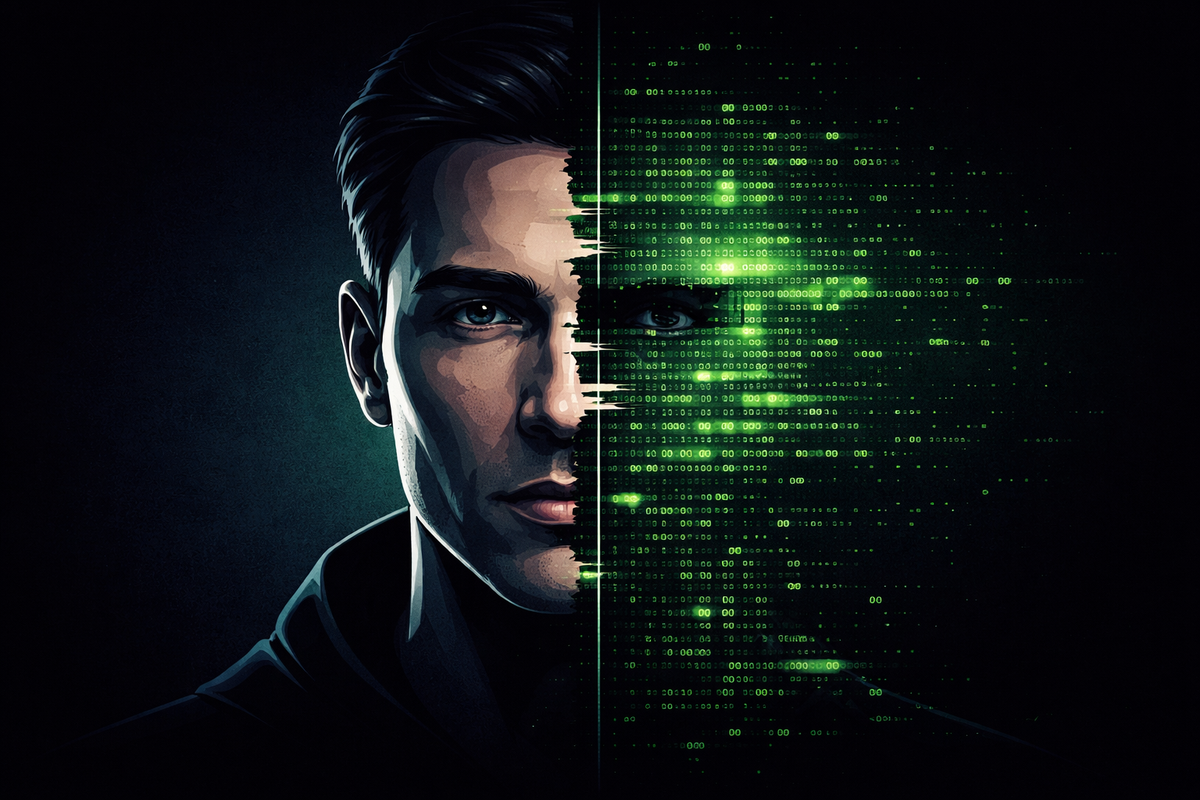
In 2026, seeing and hearing is no longer believing. A finance worker can join a video call, recognize the chief financial officer and several colleagues, follow their instructions to move money — and later learn that every face and voice on the screen was synthetic. Deepfakes have moved from a novelty on internet forums to a working tool for fraud, extortion and disinformation, and the barrier to producing a convincing one keeps falling.
A deepfake is synthetic media — video, audio or images — generated or altered by artificial intelligence to make a real person appear to say or do something they never did. The term combines “deep learning” and “fake,” and first surfaced on Reddit in late 2017. Modern deepfakes are built with neural networks that study real footage of a target and then produce new, highly realistic content that mimics their face, voice and mannerisms.
How Deepfakes Are Made: GANs, Diffusion Models, and Voice Cloning
Most deepfakes rely on one of three generative techniques. Generative adversarial networks (GANs) pit two neural networks against each other: a generator produces fakes while a discriminator tries to catch them, and the competition drives realism upward with every round. Diffusion models — the same family behind modern image generators — start from noise and iteratively refine it into a photorealistic frame, and have become the state of the art for synthetic images and video. Autoencoders compress and reconstruct faces to swap one identity onto another in video.
Audio is often the weakest link because it is the cheapest to fake. Commercial voice cloning can produce a convincing copy of a specific person from only a few seconds of clean audio — the kind anyone with public earnings calls, podcasts or social videos leaves lying around. That is why voice has become the entry point for so much fraud: it is fast, requires little source material, and travels well over a phone line where quality is already low. Understanding how AI is used in cyberattacks makes clear that deepfakes are rarely the whole attack — they are the trust-building layer bolted onto an older scam.
The 2026 Deepfake Threat Landscape
The most expensive deepfake attacks are not viral political videos — they are quiet, targeted fraud. Below is the anatomy of the pattern that has cost organizations the most: a synthetic voice and face wrapped around a classic business email compromise wire request.
● ANATOMY OF A DEEPFAKE WIRE-FRAUD CALL How a synthetic voice and face turn a routine finance request into a seven-figure loss. |
1 · HARVEST Attackers scrape an executive’s face and voice from earnings calls, conference talks and social video — roughly three seconds of clean audio is enough to clone a voice. |
| ↓ |
2 · SYNTHESIZE A GAN or diffusion model plus a voice clone produce a real-time avatar of the “CFO” that can hold a live video conversation. |
| ↓ |
3 · THE CALL A finance employee joins a video meeting where every “colleague” is AI-generated and is pressured to approve an urgent, confidential transfer. |
| ↓ |
4 · THE PAYOUT Multiple wires clear before anyone reaches the real executive. In the Arup case, one worker sent 15 transfers worth about $25 million. |
Source: Hong Kong Police Force / CNN reporting on Arup; Entrust 2025 Identity Fraud Report. |
The canonical case is engineering firm Arup: in early 2024, an employee in its Hong Kong office authorized 15 transfers worth about $25 million after a video conference in which every other participant — including the CFO — was an AI-generated fake, a loss later confirmed by the Hong Kong Police Force. Attempts against Ferrari and advertising giant WPP that same year used cloned executive voices but were foiled — in Ferrari’s case by a staffer who asked the “CEO” a question only the real person could answer. In 2026, The CyberSignal watched a real-time deepfake tool impersonate a reporter live on a video call, the same technology now industrialized inside scam compounds.
Beyond executive fraud, deepfakes power several distinct harms. Non-consensual intimate imagery remains the largest single category of deepfake content online and overwhelmingly targets women. Election and disinformation operations use fabricated clips of politicians to mislead voters. Identity and KYC bypass uses synthetic faces and injected video to defeat biometric onboarding — Entrust’s 2025 report attributes a large and growing share of biometric fraud to deepfakes. And the FBI has warned that criminals now impersonate its own officials in deepfake videos to re-victimize fraud targets.
Types of Deepfakes
Not all deepfakes are video, and the defenses differ by format. The main categories:
| Type | What it is | Where it shows up |
|---|---|---|
| Face swap / video | One person’s face mapped onto another in recorded or live video. | Fake executive video calls, fabricated statements, non-consensual imagery. |
| Voice cloning | A synthetic copy of a specific person’s voice built from a short audio sample. | Vishing calls, CEO-fraud “confirmation” calls, family-emergency scams. |
| Synthetic images | Wholly AI-generated faces or scenes of people who may not exist. | Fake IDs and selfies for KYC bypass, sock-puppet accounts, disinformation. |
| Real-time avatars | Live puppeteering that reanimates a face and voice during a call. | Interactive video-call fraud and romance/“pig-butchering” scams. |
Why Deepfake Detection Is So Hard
Detection is a moving target. Every improvement in a detector becomes training signal for the next generation of generators — the same adversarial dynamic that makes GANs work in the first place. Automated tools look for tells the human eye misses: inconsistent lighting and shadows, unnatural blinking, lip-sync drift, or spectral artifacts in audio. The problem is that these tells vanish as models improve, and detectors that score well in the lab degrade sharply in the wild. NIST research has found that detection accuracy can fall by roughly 45–50% when systems move from clean academic benchmarks to real-world conditions.
Humans fare worse. Controlled studies have found people correctly identify high-quality deepfake video only about a quarter of the time, and in one 2025 experiment barely any participants could reliably tell real from fake across a set of images and clips. The practical takeaway: do not rely on the naked eye, and do not rely on any single detector. Detection is one layer, not a solution.
How to Defend Against Deepfakes
Because detection alone is unreliable, the strongest defenses attack the deepfake’s purpose rather than trying to spot the pixels. The goal is to make a synthetic voice or face insufficient to authorize anything that matters.
- Verify through a second, out-of-band channel. Any urgent money movement or credential change should be confirmed on a known-good number or in person — never approved solely on the strength of a call or video. A pre-agreed challenge question or code word between executives and finance staff defeats most real-time impersonation.
- Deploy provenance, not just detection. Content Credentials from the C2PA standard and watermarks such as Google DeepMind’s SynthID attach cryptographically signed origin metadata to media, shifting the question from “is this fake?” to “can this prove where it came from?”
- Use liveness detection for biometrics. Identity and onboarding systems should require active liveness checks and injection-attack detection so a replayed or synthetic video cannot pass a KYC flow.
- Harden the accounts behind the request. Deepfakes usually accompany a compromised inbox or account. Strong multi-factor authentication and identity controls remove the foothold the scam is built on.
- Train people on the specific pattern. Employees should know that urgency, secrecy and a request to bypass process are the real signals — the same phishing and social-engineering cues, now delivered by a familiar face.
The Regulatory Picture
There is no single U.S. federal law banning deepfakes, but existing statutes on fraud, wire fraud, defamation and identity theft already apply when synthetic media is used to harm. The TAKE IT DOWN Act, signed in May 2025, criminalizes non-consensual intimate imagery — including AI-generated — and requires platforms to remove it quickly. Dozens of U.S. states have passed their own laws, most targeting election deepfakes and non-consensual content. In the EU, the AI Act imposes transparency obligations requiring that deepfakes be labeled, and Brussels has stood up a dedicated AI enforcement team that lists deepfakes among its priorities. Enforcement, however, remains hard: attribution is difficult and offenders are often offshore.
Frequently Asked Questions
What is a deepfake in simple terms?
A deepfake is video, audio or an image that AI has generated or altered to make a real person appear to say or do something they never did — realistic enough to fool viewers who are not looking closely.
How are deepfakes created?
Neural networks — typically GANs, diffusion models or autoencoders — are trained on real footage and audio of a target, then generate new content that imitates their face, voice and mannerisms. Voice clones can be built from just seconds of audio.
Are deepfakes illegal?
The technology itself is not banned in the U.S., but a deepfake becomes illegal when used for fraud, harassment, defamation, election interference or non-consensual intimate imagery, which the 2025 TAKE IT DOWN Act specifically targets.
How can you detect a deepfake?
Automated tools flag visual, audio and behavioral inconsistencies, but accuracy drops sharply in real-world conditions and humans do poorly on their own. The most reliable defense is process: verify sensitive requests through a separate, trusted channel.
Further Reading
- The CyberSignal — How AI Is Used in Cyberattacks
- The CyberSignal — What Is Social Engineering?
- The CyberSignal — AI Security: The Complete Guide
- CNN — Finance worker pays out $25M after deepfake CFO video call
- C2PA — Coalition for Content Provenance and Authenticity
- FBI IC3 — Public alerts on deepfake and impersonation fraud