Checkmarx Documents “ViteVenom” Campaign Compromising Seven Vite npm Packages With Blockchain C2
Another JavaScript-ecosystem compromise with a novel blockchain-C2 angle — seven scoped npm packages impersonating the Vite tooling namespace, and defender inventory work this weekend.

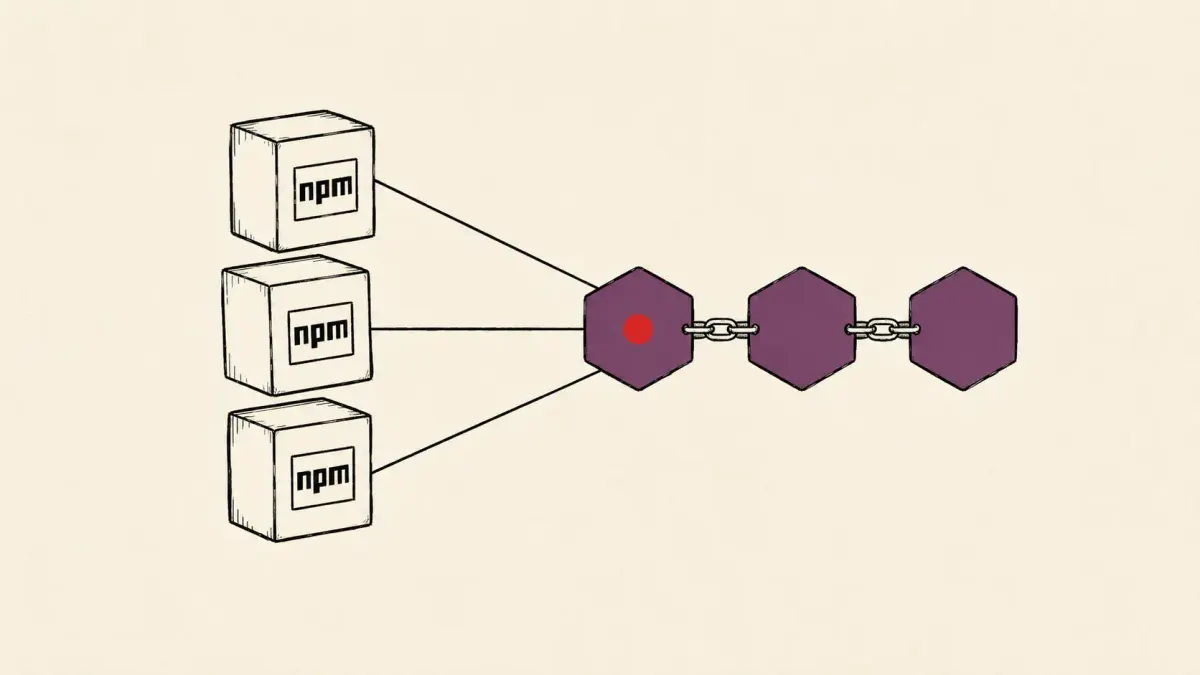
A takedown-resistant C2 design meets a familiar npm typosquat pattern — the defender task is inventory, import-path review, and credential rotation, not malware analysis.
TEL AVIV — Checkmarx on July 17, 2026 documented a software supply-chain campaign it codenamed “ViteVenom,” in which seven malicious npm packages targeting the Vite frontend tooling ecosystem delivered a remote access trojan (RAT) using command-and-control (C2) infrastructure hosted on public blockchains. The packages used scoped names built to resemble the legitimate @vitejs namespace on npm — the JavaScript and Node.js package registry — which is the detail that determines who is exposed: teams that build applications with Vite and that pulled in a lookalike dependency between late June and early July. For defenders, the first move is an inventory question, not a malware question.
The campaign was reported by The Hacker News, under the headline “Seven Malicious Vite npm Packages Use Blockchain C2 to Deliver a RAT,” drawing on Checkmarx’s analysis of the ViteVenom cluster. Checkmarx presents ViteVenom as a sequel to ChainVeil, an earlier npm campaign the same researchers documented, and the blockchain-C2 element is what has drawn attention. The CyberSignal is deliberately not reconstructing how that infrastructure is queried or what the delivered payload does once resident; those are the operator’s concerns. What matters on the defender side is a narrower and more useful claim: this C2 design was built to survive the takedown methods that normally end a campaign, which changes what a security team should expect from blocklists and domain seizures.
What Checkmarx Documented
According to The Hacker News, Checkmarx researchers identified a cluster of seven malicious npm packages aimed at developers building with Vite, the JavaScript frontend build tool. The packages were published between June 29 and July 3, 2026, and are named in full: @uw010010/vite-tree, @vite-tab/tab, @vite-ln/build-ts, @vite-mcp/vite-type, @vite-pro/vite-ui, @vitets/vite-ts, and @vite-ts/vite-ui. Reported download counts run from 1,070 for the largest down to 176 for the smallest — modest numbers by registry standards, but the relevant figure for any individual organization is binary rather than aggregate: either one of these resolved into a dependency tree or it did not.
The naming choice is the part worth dwelling on. Checkmarx notes that where the earlier ChainVeil packages were unscoped typosquats of unrelated libraries, ViteVenom uses scoped package names constructed to sit visually adjacent to the legitimate @vitejs namespace. A scope prefix reads to many developers as a signal of official provenance, and that is precisely the assumption the naming scheme is designed to borrow. Reviewers scanning a dependency diff for something obviously wrong are the intended miss.
One further reported characteristic changes where exposure lives. Per the reporting, the malicious code does not execute during package installation; it runs when the module is imported during normal use. Checkmarx notes this limits endpoint security detection, and for a defender it means the routine assumption that a removed-but-once-installed package equals a compromised host is too coarse in both directions. The question is whether a build, test, or development workflow actually imported the module.
The Blockchain-C2 Framing in Defender Terms
The headline technical feature of ViteVenom and its predecessor is that the campaign’s command-and-control (C2) pointers live on public blockchains rather than on conventional infrastructure. Checkmarx described the earlier ChainVeil operation as using what it called an “unprecedented” four-tier blockchain-based C2 arrangement spanning Tron, Aptos, and Binance Smart Chain. Checkmarx researcher Pavan Gudimalla is quoted saying the approach “makes disabling or destroying the C2 infrastructure extremely difficult,” because payload pointers sit as transaction data on public chains “rather than on domain names that can be seized.”
Translated into defender terms without reconstructing the mechanism, that claim has three practical consequences. First, the traditional endgame for a campaign of this shape — a registrar seizure, a hosting takedown, a sinkhole — does not straightforwardly apply, so a security team should not plan around the infrastructure disappearing. Second, domain and IP blocklists are a weaker control here than usual, because the durable coordination layer is not a domain. Third, the reporting notes the campaign retains a conventional fallback path over ordinary HTTP, which means egress monitoring on build agents and developer machines is still the highest-value network-side detection available.
It is worth keeping the novelty in proportion. Blockchain-anchored C2 is a resilience feature for the operator, not a new capability against the endpoint. The RAT capabilities Checkmarx describes fall into categories defenders already scope for, and the response is unchanged by the transport used to reach them.
Continuation Context: The JavaScript-Ecosystem Supply-Chain Thread
ViteVenom lands in a dense run of JavaScript-ecosystem supply-chain incidents. Days earlier, four vendors confirmed that compromised @asyncapi npm packages were distributing a multi-stage botnet loader — an incident that drew a subsequent Microsoft deep dive — and before that, researchers documented 148 npm packages disguised as student proxies that reportedly turned browsers into a DDoS botnet. No link between ViteVenom and the AsyncAPI compromise has been established, and the reporting does not suggest one; the packages, the operator, and the delivery model are all described differently.
Two prior threads are more directly instructive. The import-time trigger is a live illustration of why registry hardening has limits: when npm disabled install scripts by default for newly published packages, it closed a well-worn execution path, and campaigns have adapted by moving the trigger to module load. And the blockchain-C2 pattern itself is not unprecedented on this beat — The CyberSignal previously covered the GlassWorm botnet takedown, where researchers contended with Solana-based C2. The scoped-name impersonation, meanwhile, echoes the typosquatted npm packages Microsoft documented targeting cloud and CI/CD secrets and the cross-registry Trapdoor campaign spanning npm, PyPI, and crates. The individual techniques are all familiar; ViteVenom’s contribution is combining them against a single, widely used build tool.
Defender Posture for Organizations Using Vite
The response requires no understanding of the C2 design. Start by matching the seven named packages verbatim against lockfiles, dependency trees, and any software bill of materials — including on continuous integration runners and developer laptops, which frequently resolve dependencies that never appear in a production manifest. Because the names are scoped to resemble @vitejs, a substring search for “vite” will produce noise; match the full package names rather than eyeballing a filtered list.
Where a match is found, the reported guidance is direct: remove the package immediately, audit the surrounding dependencies, and rotate every credential that was reachable from the affected machine. Checkmarx also advises checking for unauthorized modifications to shell configuration files — .bashrc, .zshrc, and .profile — which is the kind of persistence check that is cheap to run and easy to forget. Rebuild cleanly from a pinned, known-good dependency set rather than removing the package in place.
Two scoping notes deserve emphasis. Because execution is reported to occur at import rather than install, a package present in a lockfile but never imported represents a different exposure level than one a build actually loaded — but absent reliable evidence either way, the conservative reading is the safe one. And because it is not established whether npm has removed these packages, teams should not assume the installation path is closed; add the names to whatever internal blocklist or registry proxy policy exists rather than waiting for the registry to act.
Open Questions
Several things remain unresolved. Most operationally significant is registry status: it is not established whether npm has unpublished the seven packages, which is the difference between a cleanup exercise and an open installation path. Checkmarx attributes the activity to an operator it tracks as SuccessKey and notes evidence going back to February 27, 2026, when cryptocurrency wallets it links to the campaign were activated, but that attribution rests on one vendor’s analysis and has not been independently corroborated in the reporting reviewed here.
It is also not established whether ViteVenom connects to any of the other npm compromises of the past month, including the AsyncAPI incident — and nothing in the reporting asserts such a link. Checkmarx’s own framing on the ViteVenom-to-ChainVeil relationship is careful: the firm says the surface-level differences between the clusters are “consistent with how a single operator would compartmentalize multiple distribution tracks to limit exposure,” which is an inference about tradecraft, not a confirmed identity. What is firm enough to act on is the shape of the incident: seven named packages, published in a five-day window, impersonating a widely used build tool’s namespace, with an import-time trigger and a C2 design built to resist takedown. That is enough to run the inventory, and the inventory does not depend on any of the open questions resolving. The reporting rests on the account carried by The Hacker News and Checkmarx’s published analysis.
The CyberSignal Analysis
The reported facts above come from Checkmarx’s analysis as carried by The Hacker News; what follows is The CyberSignal’s editorial reading of what defenders should take from them. None of the judgments below are new reported facts.
Signal 01 — Scoped Names Are the Underrated Half of This Campaign
The blockchain-C2 element is what earned the coverage, but the scoped-namespace impersonation is what will determine how many organizations are affected. A scope prefix carries an implicit provenance claim that most dependency reviews are not equipped to check, and it survives the glance test in a way that a bare typosquat does not. Our reading is that teams should treat scope names as an unverified string rather than a trust signal, and that the practical control is an allowlist of approved scopes at the registry proxy — a cheap, durable measure that would have blocked all seven of these packages regardless of what they contained.
Signal 02 — Takedown-Resistant C2 Shifts Weight Onto Endpoint and Egress Controls
If the infrastructure genuinely cannot be seized, then the controls that end an incident are the ones a defender owns outright. That argues for weighting egress monitoring on build agents and developer machines more heavily than domain-based blocking, and for treating the campaign as persistent rather than as something that expires when someone files a takedown. The reported HTTP fallback path is a useful reminder that operators keep conventional options open, which means conventional detections retain value even against unconventional infrastructure. We would not overread the novelty: this is a durability improvement for the operator, not a new class of threat.
Signal 03 — Import-Time Execution Is the Pattern to Internalize
The move from install-time to import-time execution is the most transferable lesson here, and it now appears often enough to be treated as the default assumption rather than a twist. It defeats install-script hardening, reduces endpoint detection surface, and breaks the convenient shorthand that a lockfile entry equals a compromised host. Our assessment is that organizations should build the capability to answer “which machines actually imported this module” as a standing question, because they will be asked it again. Teams that can answer from existing telemetry will scope these incidents in hours; teams that cannot will default to rotating everything — correct, but expensive.



