Cybersecurity 101
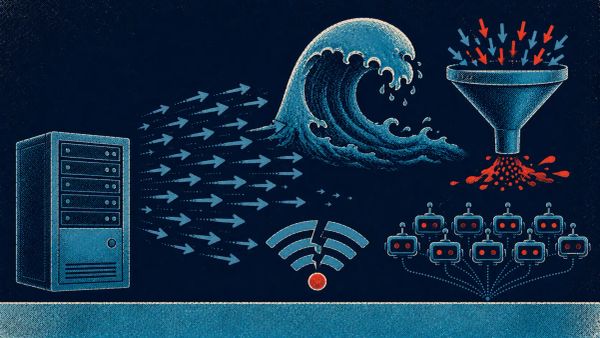
What Is a DDoS Attack and How Does It Work?
A complete guide to DDoS attacks — how distributed denial-of-service attacks work, the main types, why attackers launch them, and how to defend against them.
Master the fundamentals of digital safety. Explore our foundational guides on cybersecurity basics, from protecting personal data to understanding core security protocols.
Cybersecurity 101
A complete guide to DDoS attacks — how distributed denial-of-service attacks work, the main types, why attackers launch them, and how to defend against them.
Cybersecurity 101
A complete guide to malware — the major types, how it spreads and infects devices, the warning signs of an infection, and how to remove and prevent it.
Cybersecurity 101
A complete guide to incident response — the six-phase lifecycle, the response team, plans and playbooks, frameworks, and the practices that limit breach damage.
Cybersecurity 101
A complete guide to vulnerability management: what vulnerabilities are, how they are scored and disclosed, the management lifecycle, and how to build a program.
Cybersecurity 101
A complete guide to the major types of cyberattacks — from malware and phishing to injection, credential, and AI-enabled attacks — and how to defend against each.
Cybersecurity 101
Swift containment is one of the most critical phases of modern cybersecurity. In this blog post, we provide in-depth, accessible information about swift containment and its role in protecting organizations from evolving cyber threats. As cyber threats grow more sophisticated and attack surfaces expand across hybrid environments, organizations must respond
Cybersecurity 101
Introduction to Deepfake Technology A deepfake is a form of synthetic media where artificial intelligence is used to create highly realistic fake videos, fake images, or audio recordings that depict a real person doing or saying something they never did. A deepfake is an artificial image or video generated by
Cybersecurity 101
A strong password is the first line of defense in protecting your online accounts, sensitive information, and digital identity. As cybercriminals become more advanced, weak passwords and reusing passwords across multiple accounts remain one of the biggest causes of data breaches. Using an eight character password is no longer sufficient,
Cybersecurity 101
Critical infrastructure security is the foundation of modern national security, economic security, and national public health. The nation's critical infrastructure includes the assets, networks, and services that provide functions essential to daily life, from energy and transportation systems to water and wastewater systems and emergency services. Due to
Cybersecurity 101
Account takeover (ATO) is one of the fastest-growing threats in cybersecurity today. Account takeover (ATO) is a type of identity fraud where fraudsters leverage a person's existing credentials to take control of their financial, credit, email, or social media accounts. As more user accounts move online across banking,
Cybersecurity 101
Supply chain attacks are a rapidly evolving class of cyber threats that exploit the complex web of trust between organizations and their external partners. In today’s interconnected digital landscape, businesses rely on a vast network of vendors, service providers, and open-source components to build, deliver, and maintain their software.
Cybersecurity 101
An advanced persistent threat (APT) represents one of the most dangerous categories of modern cyber threats. These attacks are considered sophisticated threats due to their complexity and the advanced tactics used by attackers. Unlike opportunistic attacks, an advanced persistent threat attack is carefully planned, highly targeted, and executed over an