CyberScoop Reports SonicWall SMA 1000 Zero-Days Were Reportedly Exploited Three Weeks Before Vendor Disclosure
A three-week pre-disclosure exposure window for the SonicWall SMA zero-days — defender teams review the timeline this week.

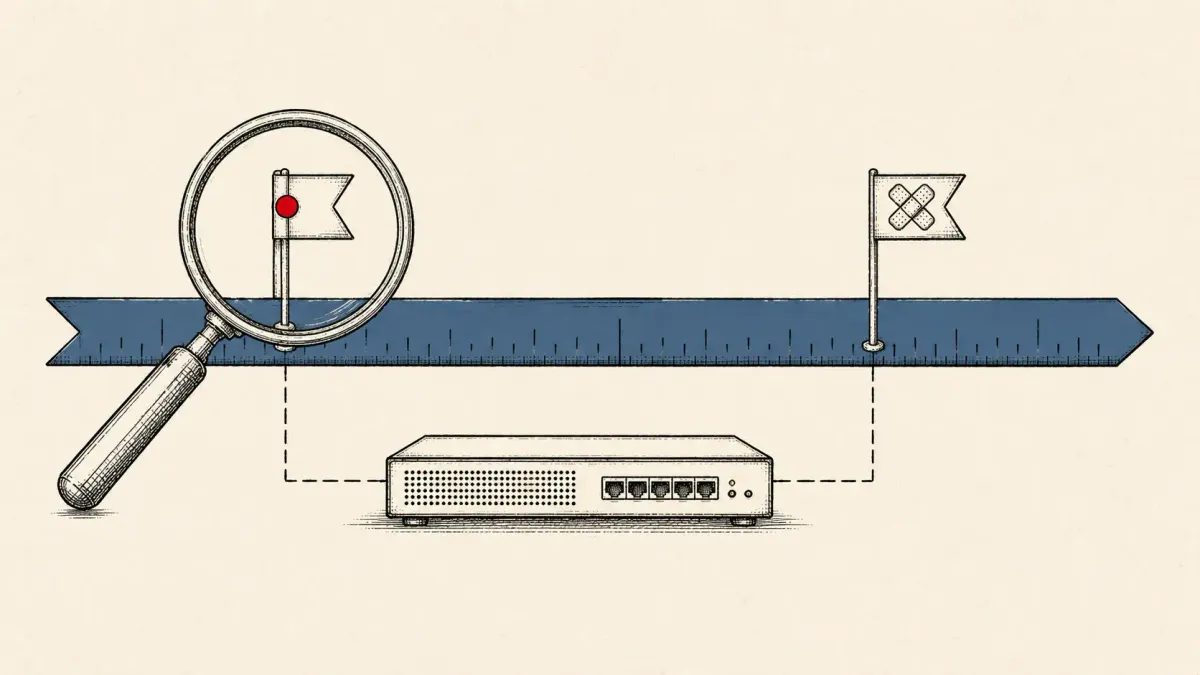
A reported three-week gap between first exploitation and disclosure reframes the SonicWall SMA 1000 zero-days as a timeline problem — and puts compromise assessment, not just patching, at the top of the defender checklist.
BOSTON, MASSACHUSETTS — The two SonicWall Secure Mobile Access (SMA) 1000-series zero-days that the vendor disclosed and patched on July 14, 2026 were reportedly being exploited in the wild for about three weeks before that disclosure, according to reporting published by CyberScoop on July 15. The outlet, under the headline "SonicWall customers under threat as attackers exploit 2 zero-days," reported that the two flaws — CVE-2026-15409 and CVE-2026-15410 — were reportedly chained together in the attacks, and that researchers dated the earliest known exploitation to well before the advisory reached defenders. For teams running SMA 1000 appliances at the network edge, that reported timeline changes the nature of the job: the question is no longer only whether an appliance is patched, but whether it was already reached during the weeks it sat exposed.
The pre-disclosure activity was reportedly surfaced by Rapid7's Managed Detection and Response (MDR) team, whose blog — "Rapid7 MDR Team Discovers New SonicWall SMA1000 Zero Days being Actively Exploited" — documents the two CVEs and the chaining. This piece is a defender-oriented reading of that reported timeline and continues The CyberSignal's coverage of the same product thread, from the initial SMA 1000 zero-day disclosure to the CVE-level detail on CVE-2026-15409 and CVE-2026-15410. We keep the chaining description in defender terms and do not reconstruct how the two flaws combine.
What CyberScoop and Rapid7 Documented
According to CyberScoop's July 15 report, SonicWall publicly disclosed CVE-2026-15409 and CVE-2026-15410 in a security advisory on July 14, but researchers said the flaws had reportedly been exploited weeks earlier — placing the earliest known activity roughly three weeks ahead of the disclosure. Rapid7's Managed Detection and Response team is credited with observing the pre-disclosure exploitation; the firm's Seth Lazarus told CyberScoop the observed goal was likely ransomware and that overlapping tradecraft across cases pointed to a single actor or group. SonicWall confirmed to CyberScoop that the two vulnerabilities were chained together, and said it monitors roughly one million sensors globally, of which SMA 1000 appliances are a small subset of fewer than 5,000 units.
The Rapid7 MDR blog documents CVE-2026-15409 as a critical server-side request forgery (SSRF) issue rated CVSS 10.0 and CVE-2026-15410 as a local privilege escalation vulnerability, and states that both are being actively exploited in the wild. Consistent with The CyberSignal's defender-first policy, this article does not reconstruct how the two flaws are combined; the operative facts for defenders are the reported three-week window, the reported chaining, and the vendor's confirmation that a fix is now available.
Continuation Context: The SonicWall SMA 1000 Thread
This is the third entry in a running thread. The initial disclosure coverage established that SMA 1000 appliances were under active zero-day attack via the two CVEs; the follow-up CVE-level detail recorded CVE-2026-15409 as a CVSS 10.0 SSRF and CVE-2026-15410 as a local privilege escalation. The new reporting adds the one variable those earlier entries could not pin down: how long the appliances were reportedly exposed before anyone outside the attackers knew. That variable belongs to the same family of edge-appliance timelines defenders have worked through repeatedly this cycle — including Ivanti Sentry appliances reportedly exploited within 24 hours of disclosure and the Palo Alto GlobalProtect authentication-bypass flaw under active exploitation. Each reinforces the same reading: with remote-access appliances, the gap between first exploitation and public awareness is where the damage accumulates.
Defender Takeaways on the Exposure Window
A reported three-week head start reframes the entire response. If exploitation reportedly began roughly three weeks before the patch, then patching now closes the door but says nothing about whether someone already walked through it. The defender assumption for any internet-facing SMA 1000 appliance should therefore be compromised-since-before-disclosure until a forensic review proves otherwise. In practice that means three parallel tracks: apply the vendor's fixed release, preserve and review appliance logs across the full reported window rather than only recent days, and rotate administrative credentials and session secrets on the assumption they may have been exposed while the appliance was reachable.
The exposure-window framing also sets the scope of the log review. A team that only inspects the days around disclosure risks missing the earliest, quietest activity — precisely the period a pre-disclosure timeline is warning about. The same discipline defenders applied to the Check Point VPN zero-day tied to Qilin ransomware applies here: when a remote-access appliance is confirmed exploited as a zero-day, treat the review period as the whole plausible exposure window, not the news cycle.
The CVE-Chaining Detail
SonicWall confirmed to CyberScoop, and Rapid7 documented, that the two flaws were reportedly chained together in the observed attacks. For defenders the relevant point is not the mechanics of the combination — which this article deliberately does not reconstruct — but its consequence for remediation logic: because the reported activity involves both CVEs working together, a response that addresses only one of the two is incomplete. The vendor's fixed release covers both, which is why the guidance reduces to applying the current platform hotfix and then verifying each appliance runs that exact build. Chaining raises the stakes of partial patching; it does not change the instruction to bring every appliance to the vendor-specified fixed version and confirm it there.
The CISA KEV Addition
CISA added both CVE-2026-15409 and CVE-2026-15410 to its Known Exploited Vulnerabilities catalog on July 14, 2026, per CyberScoop and Rapid7 — converting the reporting's implied urgency into a formal, dated obligation for U.S. federal civilian agencies and a de facto priority for everyone else. Defenders should confirm the exact remediation deadline directly in the KEV catalog and wire that date into their vulnerability-management workflow. KEV listings for actively exploited edge-appliance flaws are a familiar pattern — recent additions covering Ubiquiti and Lantronix devices and mobile-endpoint platforms such as Ivanti EPMM show — and they consistently rank among the most reliable near-term intrusion predictors. The broader industry signal reinforces the point: Verizon's 2026 DBIR found that vulnerability exploitation has overtaken credential theft as the top initial-access vector, and internet-facing appliances are where that shift bites hardest.
Open Questions
Several defender-relevant facts remained open at report time and should be tracked rather than assumed. The exact date exploitation reportedly began was not established beyond the roughly three-week framing. No threat actor was named, and while Rapid7 characterized the likely goal as ransomware and pointed to overlapping tradecraft across cases, attribution to a known group was not made. The total confirmed count of victim organizations during the reported window was not disclosed; SonicWall said it had investigated multiple cases of active exploitation but did not quantify impact.
The exact KEV remediation deadline should be confirmed against the catalog directly rather than inferred. Until those values are pinned down, the defender task is unchanged and needs none of them to begin: inventory every internet-facing SMA 1000 appliance, apply the vendor's fixed release, and review logs across the full plausible exposure window on the assumption that the reported three-week head start may have been used.
The CyberSignal Analysis
The reported facts above come from CyberScoop's reporting and Rapid7's MDR blog; what follows is The CyberSignal's editorial reading for defenders. None of the judgments below are new reported facts, and none depend on exploitation mechanics we have deliberately omitted.
Signal 01 — The Exposure Window Is the Story, Not the CVE Count
Two CVEs and a patch are a routine advisory; a reported three-week pre-disclosure window is not. The defining variable here is time — the interval during which internet-facing appliances were reportedly reachable before anyone outside the attackers knew a flaw existed. Our reading: for SMA 1000 operators, the patch is the easy half and the forensic review across that full window is the half that determines the actual outcome. A team that patches and moves on has closed the vulnerability while leaving unanswered the only question the timeline actually raises — whether the appliance was already reached. The pre-disclosure framing is, in effect, an instruction to scope the log review to weeks, not days.
Signal 02 — Chaining Makes Partial Remediation a Trap
Reported chaining changes the remediation calculus in one specific way: it removes any comfort from addressing a single CVE. When two flaws are reportedly used together, a response that treats them as independent line items can leave a viable path intact. The practical safeguard is boring and effective — apply the vendor's fixed platform hotfix, which covers both CVEs, and then verify each appliance against the exact fixed build the advisory names rather than assuming a build looks current. We have watched this failure mode recur on other appliance advisories: teams patch to a version that appears up to date, declare victory, and later find the fixed release was a different number. Chaining raises the cost of that mistake.
Signal 03 — Treat KEV Timing as the Floor, Not the Trigger
The CVEs are on CISA's KEV catalog, which sets a formal deadline for federal civilian agencies and a strong prioritization signal for everyone else. But the reporting predates and exceeds that formality: exploitation was reportedly under way for weeks before disclosure, so a KEV deadline measured from July 14 describes when remediation must be complete, not when the risk began. Our reading is that credible reporting of pre-disclosure exploitation should itself trigger emergency action, with the KEV deadline functioning as the outer bound rather than the starting gun. Teams that wire KEV monitoring into their process learn of the dated obligation the moment it exists; teams that also treat exploitation reporting as an independent trigger are the ones that compress the window between awareness and action.