Researchers Disclose Unpatched Claude for Chrome Flaw Tied to Gmail, Calendar Reads
An AI-browser extension disclosure with cross-tenant data implications — defender review for Claude for Chrome deployments this week.

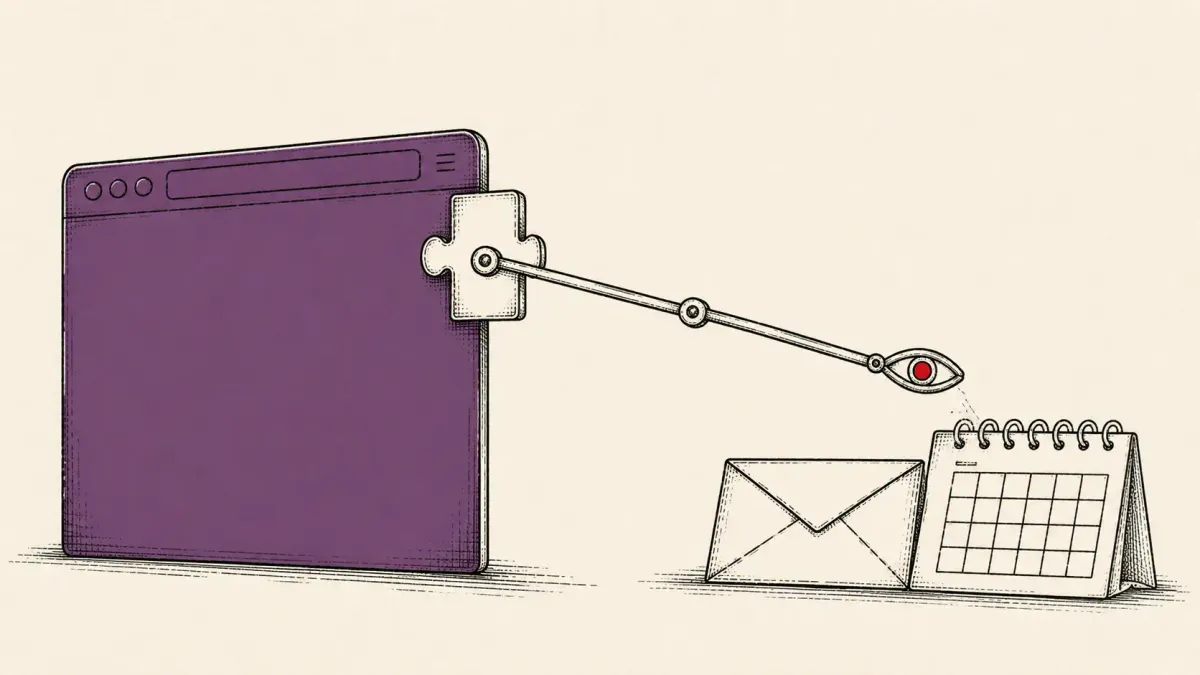
An AI-browser extension disclosure with cross-tenant data implications — the defender review for Claude for Chrome deployments centers on extension inventory, permissions, and monitoring.
SAN FRANCISCO, CALIFORNIA — Security researchers on July 14, 2026 disclosed what they describe as an unpatched flaw in Anthropic's Claude for Chrome browser extension that could allow rogue browser extensions running on the same machine to trigger reads of a user's Gmail and Calendar data. According to the disclosure, the issue is a trust-boundary weakness that lets another installed extension prompt the AI assistant to act on connected accounts without a deliberate, user-initiated approval. The researchers say they reported the underlying problem earlier and that it remained reproducible in the extension's current release at the time of publication.
The finding was covered by The Hacker News and SecurityWeek, both of which frame it as a defender-relevant disclosure rather than evidence of active abuse. For security teams the practical question is not the mechanics of the researchers' proof of concept but the exposure model it illustrates: an AI browser extension that holds standing access to a user's mailbox and calendar becomes a shared resource that other software on the same profile may be able to influence. This piece treats the disclosure as neutral vendor-disclosure coverage and focuses on what teams running the extension should inventory, restrict, and monitor. It continues our earlier reporting on AI-browser credential exposure.
What Researchers Disclosed
The researchers reported a flaw in the Claude for Chrome extension — the browser add-on that lets Anthropic's Claude assistant read and act on web content and connected services on a user's behalf. According to The Hacker News, the weakness could allow a rogue browser extension installed on the same browser profile to cause Claude for Chrome to perform reads against connected accounts, including a user's Gmail and Calendar, without a deliberate action by the person at the keyboard. The disclosure characterizes the problem as a failure to properly distinguish a genuine user-initiated request from one originating with other software sharing the browser.
In keeping with defender-focused coverage, this article does not reconstruct the researchers' technique or the specific extension-abuse path. The salient point for security teams is the exposure model rather than the exploit: an AI assistant extension that is authorized to read a mailbox and calendar concentrates high-value data behind a permission the user granted once, and the disclosure argues that authority can be reached by other extensions on the same profile. The researchers say the issue traces to an earlier report and remained reproducible in the version shipping at the time they went public, which is why they describe it as unpatched.
Two outlets carried the disclosure. SecurityWeek reported it under the headline that the unpatched flaw lets extensions read Gmail and Calendar, while The Hacker News framed it around rogue extensions triggering Gmail reads. Both accounts agree on the core facts relevant to defenders: the target is Anthropic's Claude for Chrome extension, the reachable data includes Gmail and Calendar, and the flaw was unpatched when disclosed. Neither report claims the technique has been observed in active attacks.
Where This Fits in the AI-Browser Exposure Story
This disclosure is a continuation of a theme The CyberSignal has tracked through 2026: as AI assistants gain the ability to read email, calendars, and documents through browser and agent integrations, the assistant itself becomes a new class of privileged software whose trust boundaries matter as much as the accounts behind it. The pattern first surfaced sharply in our coverage of AI-browser credential exposure, where the value of standing access outlived any single session. It echoes in adjacent research on agent-layer trust failures, including Microsoft's MCP tool-poisoning findings and the rogue-agent flaw disclosed in Google's Dialogflow CX.
The common thread is that an AI system's authority — its connected mailbox, its calendar, its ability to take actions — can be steered by inputs the user never intended to send. We have seen variations in persistent-memory manipulation research such as MemGhost and in prompt-injection work against consumer assistants like OpenAI's ChatGPT and Google's Gemini voice assistant. The Claude for Chrome disclosure adds a browser-extension dimension: the influence reportedly comes not from a poisoned web page but from another extension co-resident in the same profile, which places the browser's own extension model at the center of the risk.
Defender Posture for Organizations Running the Extension
For organizations that have deployed the Claude for Chrome extension, the disclosure is best treated as a prompt to review extension governance rather than as an emergency. The first step is inventory: know which managed endpoints have the Claude for Chrome extension installed, which users have connected Gmail and Calendar to it, and what other extensions are present in those same browser profiles. The disclosure's scenario depends on another extension being installed alongside the AI assistant, so a browser profile with a tightly controlled, small set of vetted extensions presents materially less exposure than one where users can install add-ons freely.
From there the controls are the familiar least-privilege set applied to the browser rather than the network. Enterprise browser-management policies in Chrome can restrict extension installation to an allowlist, block extensions that request broad host permissions, and force-remove unreviewed add-ons; tightening those policies directly shrinks the population of co-installed extensions that could interact with the AI assistant. Teams should also review whether the AI extension needs standing connections to email and calendar for the users who have it, and remove connected-account authority where the workflow does not require it. Reducing what the assistant can reach reduces what any influence over it can obtain. The CyberSignal later reported a separate Anthropic agentic-tool flaw, a Claude Cowork sandbox escape that could reach files across a Mac.
Monitoring is the third pillar. Because the reachable data lives in Google Workspace accounts, defenders are not blind to unusual access even without visibility into the extension's internals: Workspace audit logs, alerting on anomalous mail and calendar access patterns, and endpoint telemetry on newly installed extensions all provide detection surface. The durable posture is to treat an installed AI browser extension as privileged software subject to the same inventory, permission-minimization, and monitoring discipline applied to any other tool with access to sensitive mailboxes.
Anthropic's Response and What to Watch
At the time of writing, Anthropic's official response to this specific disclosure was not confirmed. Reporting indicates the researchers had engaged the vendor about the underlying issue previously, but The CyberSignal is not attributing any public statement, patch commitment, or timeline to Anthropic that has not been verified. We will update this article if Anthropic publishes an advisory, ships a fix, or otherwise addresses the finding.
Several adjacent facts are similarly unconfirmed and are held to the standard the disclosure warrants. There is no confirmation that Google issued an extension-store advisory in response, no confirmed count of affected users, and no evidence presented of exploitation in the wild. Defenders watching this space will want to track any Anthropic advisory, any change in the extension's release notes indicating a fix, and any guidance from Google on the browser-extension trust model — the same governance surface implicated in earlier action against malicious Microsoft Edge extensions. Until those land, the review described above stands on its own regardless of the vendor timeline.
Scope and Impact
The confirmed scope of the disclosure is narrow and specific: researchers describe an unpatched flaw in the Claude for Chrome extension that could let a rogue, co-installed browser extension trigger reads of connected Gmail and Calendar data. The impact that matters to defenders flows from the data category, not the novelty of the technique. Email and calendar content is a rich source for follow-on social engineering, business-email-compromise setup, and reconnaissance of an organization's people and schedules, which is why standing programmatic access to it warrants careful governance even when no active abuse is known.
The population at risk is bounded by deployment. Only browser profiles that have the Claude for Chrome extension installed, with Gmail and Calendar connected, and with at least one other untrusted extension present, match the scenario the researchers describe. That intersection is where an organization's attention should concentrate. For most enterprises the mitigations are already available in existing browser-management tooling, and the disclosure is a reason to apply them deliberately rather than an indication that they have failed.
The broader impact is directional. Each of these AI-assistant trust-boundary disclosures narrows the assumption that an assistant's connected access is safe simply because the account authentication behind it is sound. The lesson defenders should carry forward is that granting an AI tool standing access to a mailbox creates a new asset to inventory and defend — one whose exposure is shaped by the surrounding software environment as much as by the credentials it holds.
Open Questions
Key facts remain open at the time of disclosure. Anthropic's official response — whether it acknowledges the finding, disputes the characterization, or commits to a fix and on what timeline — is not confirmed, and no verified vendor statement is attributed here. It is likewise unconfirmed whether Google has issued or plans any extension-store advisory addressing the browser-extension trust model the disclosure implicates.
The scale and real-world status of the issue are also unresolved. There is no confirmed count of affected users, no confirmed evidence of exploitation in the wild, and no independent confirmation beyond the two reports that carried the disclosure — The Hacker News and SecurityWeek. As with any freshly disclosed research finding, specifics may evolve: the precise reachable data set, whether a fix is already in progress, and the eventual patch timeline are the items most likely to move. The CyberSignal will follow the vendor response and update accordingly.
The CyberSignal Analysis
The reported facts above are the researchers' and the outlets that carried the disclosure; what follows is The CyberSignal's editorial reading of what defenders should take from them. None of the judgments below are new reported facts, and none should be read as attributing a position to Anthropic.
Signal 01 — The AI Extension Is Now Privileged Software in Its Own Right
The durable lesson is not that one browser extension had a flaw but where the flaw sits in the trust model. An AI assistant that holds standing access to Gmail and Calendar is no longer just a productivity add-on; it is privileged software with a persistent grant to sensitive data. Our reading is that defenders should classify installed AI browser extensions the way they classify any tool with mailbox access — as an asset to inventory, permission-scope, and monitor, not as a convenience to wave through.
That reframing changes the default question from 'is the assistant trustworthy?' to 'what can influence the assistant, and what can it reach if influenced?' The disclosure's value for defenders is that it makes the second question concrete, and the answer is bounded by choices teams already control: which extensions are allowed on a profile and how much account authority the assistant is given.
Signal 02 — Extension Co-Residency Is the Exposure Surface to Govern
The scenario the researchers describe depends on another extension sharing the browser profile with the AI assistant. That makes the browser's extension model — not the network perimeter — the surface that matters here. Our assessment is that the single most effective control is an enforced extension allowlist: a profile carrying only vetted, necessary extensions removes the co-resident software the disclosure relies on. This is a control most enterprises already have in Chrome management and simply have not tightened around AI tooling.
For security operations, the actionable interpretation is to audit extension inventory on endpoints running AI browser assistants and to treat unreviewed extension installs on those profiles as a governance gap worth closing. The defenders who bound this class of issue are the ones who manage what runs next to their privileged AI tools, not only what the AI tools themselves are.
Signal 03 — Vendor Timeline Is Uncertain, So the Control Must Not Depend On It
With the flaw reported unpatched and Anthropic's response unconfirmed at disclosure, defenders cannot anchor their posture to a fix that may or may not have shipped. Our view is that the right stance treats the vendor timeline as an unknown and leans on controls the organization owns outright — extension allowlisting, connected-account minimization, and Workspace-side monitoring — which hold regardless of when or whether a patch lands.
The forward-looking watch item is the vendor response itself: an Anthropic advisory or an updated release note would change the calculus, as would any Google guidance on extension trust. Until then, we would treat this as a standing reason to review AI-extension governance rather than as an incident awaiting a single patch, and we expect further disclosures in this AI-browser category to reinforce the same discipline.