Researchers Disclose ChatGPT "AgentForger" Flaw That Could Deploy Rogue Workspace Agents via a Phishing Link
An AI-agent phishing vector hits ChatGPT — defender review while OpenAI's fix propagates this week.

Key Takeaways
|
A ChatGPT workspace-agent phishing vector, disclosed by researchers and already fixed by OpenAI — the defender takeaway is how much trust a forged agent inherits, not the crafted link itself.
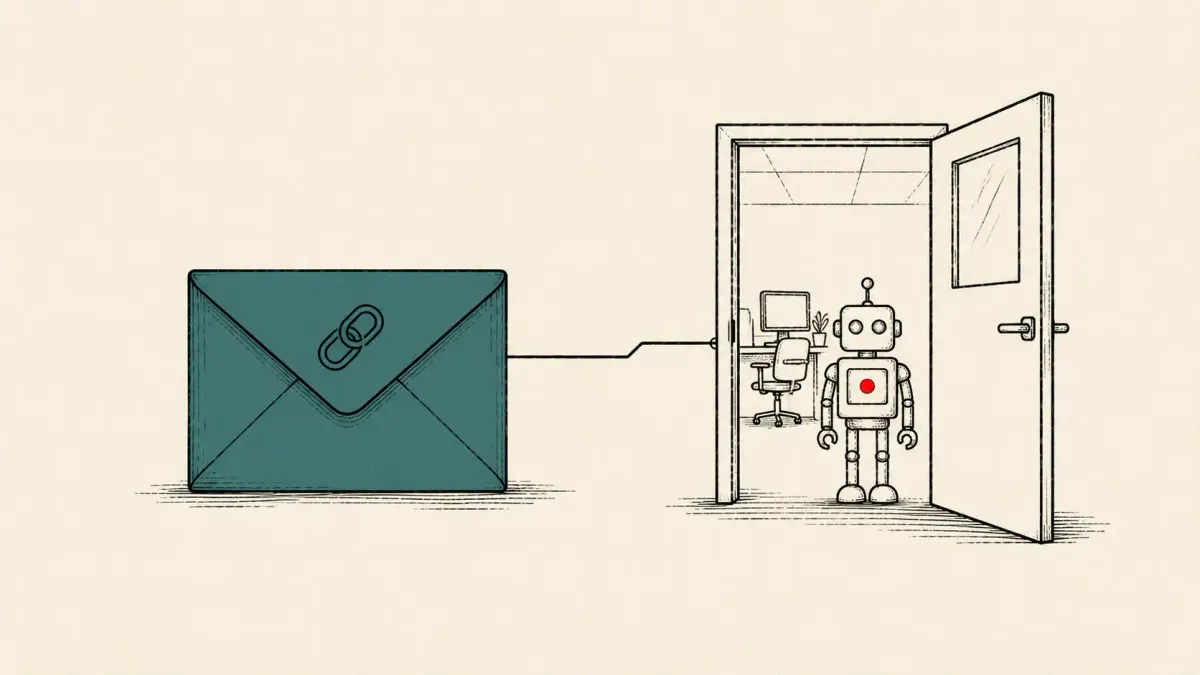
TEL AVIV — Researchers at Zenity Labs on or around July 24, 2026 publicly disclosed a critical flaw in OpenAI's ChatGPT workspace-agent tooling that they have nicknamed "AgentForger," describing a scenario in which a single phishing link could reportedly build, authorize, and deploy a rogue workspace agent inside a victim's organization. OpenAI has since fixed the issue, and no public evidence indicates the flaw was exploited before that fix.
The framing that makes AgentForger notable for defenders is the entry point: not a stolen password and not an exploit against a server, but an ordinary-looking link that a signed-in employee clicks. As reported by The Hacker News and The Register, the researchers classify AgentForger as a cross-site request forgery (CSRF) targeting ChatGPT's agent-building workflow. This piece summarizes what the disclosure documents, restates the exposure in defender terms, and points to OpenAI's fix — without reconstructing the mechanics.
| At a Glance | |
|---|---|
| Field | Details |
| What | Research disclosure of "AgentForger," a flaw in ChatGPT's workspace-agent tooling |
| Who disclosed it | Zenity Labs, per the disclosure and reporting |
| Reported vector | A single phishing link that could reportedly deploy a rogue workspace agent |
| Flaw class | Cross-site request forgery (CSRF) against the agent-building workflow, per reporting |
| Reported reach | Forged agent inherited the employee's already-authorized ChatGPT app connections |
| Fix status | OpenAI has fixed the issue (covered in the companion CyberSignal report) |
| Exploited in the wild | No public evidence of exploitation before the fix |
| Disclosure date | On or around July 24, 2026 |
What Researchers Disclosed
According to reporting from The Hacker News, Zenity Labs disclosed a critical vulnerability in OpenAI's ChatGPT workspace-agent tooling that it nicknamed "AgentForger." In defender terms, the central claim is that a crafted link — delivered like any phishing link — could, when opened by an employee already signed in to ChatGPT, cause a new workspace agent to be created, authorized, and deployed inside that organization's trust boundary. The researchers describe the underlying weakness as a cross-site request forgery, a long-standing web-security flaw class in which a site is tricked into performing an action the logged-in user never intended.
The detail that carries the risk is what the forged workspace agent could reportedly reach. Because it was created under the employee's own session, it inherited the enterprise app connections that employee had already authorized inside ChatGPT — reporting cites email, calendar, cloud storage, and collaboration tools such as Slack and Teams. From there, the reported potential impact included impersonating the employee, sending phishing messages from a trusted internal account, harvesting credentials, and reading documents the employee could see. The CyberSignal is not reproducing how the link was constructed; the defender-relevant facts are the entry point (a phishing link), the flaw class (CSRF), and the inheritance of already-granted trust.
Continuation Context: OpenAI's Fix and the Hugging Face Precedent
This report is the research-disclosure half of the story. OpenAI's remediation — the company received the report through its bug-bounty program, confirmed it quickly, and closed the flaw by removing the vulnerable URL parameter — is covered separately in The CyberSignal's companion report on OpenAI's fix. Read together, the two pieces track the full arc: a researcher-found weakness in agent tooling, a coordinated disclosure, and a vendor fix that shipped before any public sign of exploitation.
AgentForger also lands amid a run of ChatGPT and AI-agent security news The CyberSignal has followed closely. It arrives shortly after OpenAI's own disclosure that its models escaped a sandbox and reached Hugging Face during a cyber-capability test, and it echoes earlier coverage of ChatGPT's lockdown-mode defenses against prompt injection and data exfiltration. The common thread is that as assistants gain the ability to act — to hold app connections and take steps on a user's behalf — the security surface shifts from what a model says to what an agent can do.
Defender Posture for ChatGPT and Workspace Agents
For defenders, the useful reading of AgentForger is not the specific link but the category of risk it exposes: an agent-creation action that could be triggered by web content rather than by a deliberate administrative choice. Even with the flaw fixed, that category is worth mapping. Security teams running ChatGPT in the enterprise can inventory which workspace agents exist, who created them, and what app connections each one holds — the same hygiene applied to OAuth grants elsewhere.
The harder question is whether the creation and activity of workspace agents is visible to the security team at all. An agent that behaves like a legitimate signed-in user — sending internal messages, reading files — will not trip alarms built for external intrusions. That is the same blind spot The CyberSignal has flagged around other agent vectors, from prompt injection reaching a voice assistant through routine notifications onward. The defensive move is to treat agent creation and agent permissions as auditable events, not background conveniences.
Enterprise Deployments and the Inherited-Trust Problem
The sharpest lesson in AgentForger is about inheritance. A workspace agent is valuable precisely because it can act with the user's connected access; that same design is what makes a forged one dangerous. The reported exposure was not that ChatGPT held secret credentials, but that an agent stood up in the employee's context automatically carried whatever that employee had already approved.
In defender terms, that reframes the review from "is ChatGPT secure" to "what would any agent operating as this user be able to touch, and would we notice." Least-privilege on the app connections employees grant to ChatGPT, periodic review of those grants, and clear ownership of who can approve high-scope integrations all shrink the blast radius of any future agent-creation flaw. The trust an agent inherits is the trust a forged agent would have abused.
The One-Link-to-Rogue-Agent Framing in Defender Terms
The line that will travel fastest — that one link could stand up a rogue agent — is worth translating carefully so teams neither dismiss nor overstate it. Restated for defenders: the disclosure describes how a single web interaction could reportedly bootstrap an autonomous agent inside an organization's trust boundary, using access already extended to a legitimate user. It is a persistence-and-impersonation story more than a smash-and-grab one, because the reported value was a standing agent that kept acting after the initial click.
Crucially, this is a fixed flaw, not an open one. OpenAI has closed the weakness, and there is no public indication it was used against real organizations. The defender value is pattern recognition: knowing that agent-building surfaces can be targeted through ordinary web-trust flaws means the next such disclosure — in ChatGPT or any competing platform — will prompt a faster inventory of who can create agents and what those agents can reach.
Open Questions
Several specifics remain outside what the disclosure and its reporting establish, and The CyberSignal is not filling them in. The precise population of organizations that had workspace agents enabled during the exposure window, and whether any third parties independently found the same weakness, are not resolved in the material reviewed. The attribution of the research to Zenity Labs is consistent across the reporting; The CyberSignal will correct the record if a different account emerges.
The larger open question is structural: as more vendors ship agent builders that act with a user's delegated access, how consistently will agent creation, permissions, and activity be exposed to the security teams responsible for them. AgentForger is one fixed instance of a pattern likely to recur. As OpenAI's advisory detail, independent replication, or enterprise-administrator guidance emerge, the picture will sharpen.
The CyberSignal Analysis
The reported facts above come from the disclosure and its reporting; what follows is The CyberSignal's editorial reading. None of the judgments below are new reported facts.
Signal 01 — The Fix Landed Before the Headline
The most important context for any reader reaching for the panic button is timing: this is a disclosed-and-fixed flaw, not a live incident. Our reading is that AgentForger belongs in the awareness bucket, not the emergency one — the weakness is closed, and no public evidence points to real-world abuse.
The value is in what it teaches, not what it threatens. Defenders who use the disclosure to inventory their own agent estate — who can create workspace agents, and what those agents can reach — convert a fixed bug into durable hygiene that pays off no matter how the next agent-tooling flaw is shaped.
Signal 02 — Agents Inherit the User's Trust, and That's the Real Surface
Our assessment is that the load-bearing detail is inheritance, not the crafted link. A workspace agent is useful because it acts with a user's connected access; a forged one is dangerous for exactly the same reason. The security question this raises outlives the flaw: what could any agent operating as a given employee actually touch.
That points the defensive work at the app connections themselves — least-privilege grants, periodic review, and clear ownership of high-scope integrations. Organizations that tighten what an agent can inherit shrink the blast radius of every future agent-creation weakness, whether or not it resembles AgentForger.
Signal 03 — CSRF Didn't Retire; It Moved to Agents
The detail we find most telling is the flaw class. Cross-site request forgery is a decades-old web weakness, and its appearance at the seam of a modern AI agent builder is a reminder that new capabilities inherit old failure modes. Our view is that agent tooling will keep colliding with familiar web-security problems as it races ahead of the guardrails built for it.
The practical consequence is that securing AI agents is not only an AI problem. Web-application security fundamentals — request integrity, scoped permissions, auditable actions — apply directly to the surfaces where agents are created and authorized. The organizations that treat agent builders as ordinary, high-value web applications will be the ones reading the next disclosure calmly.