What Is Identity and Access Management (IAM)?
A complete guide to identity and access management — the three IAM pillars, common attacks, and the controls (MFA, SSO, PAM, zero trust) that actually work.


The single most consequential decision an attacker can force is who is allowed to do what. Once a threat actor becomes a legitimate user — with valid credentials, a real session, and the right permissions — nearly every other security control quietly stops applying. That is why identity has become the most important boundary in cybersecurity, and why the discipline that protects it has become one of the most consequential in any security program.
Identity and access management (IAM) is the framework of policies, technologies, and processes that decide who a user is, what they are allowed to do, and how those decisions are verified moment to moment. It sits at the intersection of security, IT operations, and business enablement — and when it fails, the consequences are usually severe.
This guide is a complete introduction to IAM. It explains the three foundational pillars of identity, authentication, and authorization; the most common attacks against IAM systems; the specific controls that reduce risk (MFA, SSO, PAM); and the modern architecture — zero trust — that increasingly shapes how IAM is designed. Use the links throughout for deeper explainers on specific topics.
What Is Identity and Access Management?
Identity and access management (IAM) is the discipline of ensuring the right people have the right access to the right systems at the right time — and that nobody else does. It covers the full lifecycle of digital identity: how identities are created, authenticated, granted permissions, monitored, and eventually retired.
IAM is often thought of as a technical function, but it is fundamentally a business function. Every decision about access is a decision about risk: what can this account do, who is behind it, and how confident are we that the action is legitimate?
Why IAM Matters
Stolen and misused credentials are now the most common cause of data breaches in the enterprise. Attackers do not need to break down the wall if they can walk through the front door with a valid keycard. That fundamental shift — from breaking defenses to abusing identity — has moved IAM from a background IT function to a first-order security discipline.
The financial impact follows the same pattern. Credential-based attacks tend to be some of the fastest-monetized incidents, from business email compromise to ransomware, because they bypass the layers of technical defense organizations spent years building. Investing in IAM is often the highest-leverage security investment an organization can make.
The Three Core Pillars: Identification, Authentication, Authorization
All IAM systems rest on three foundational operations, executed in order every time a user does anything sensitive.
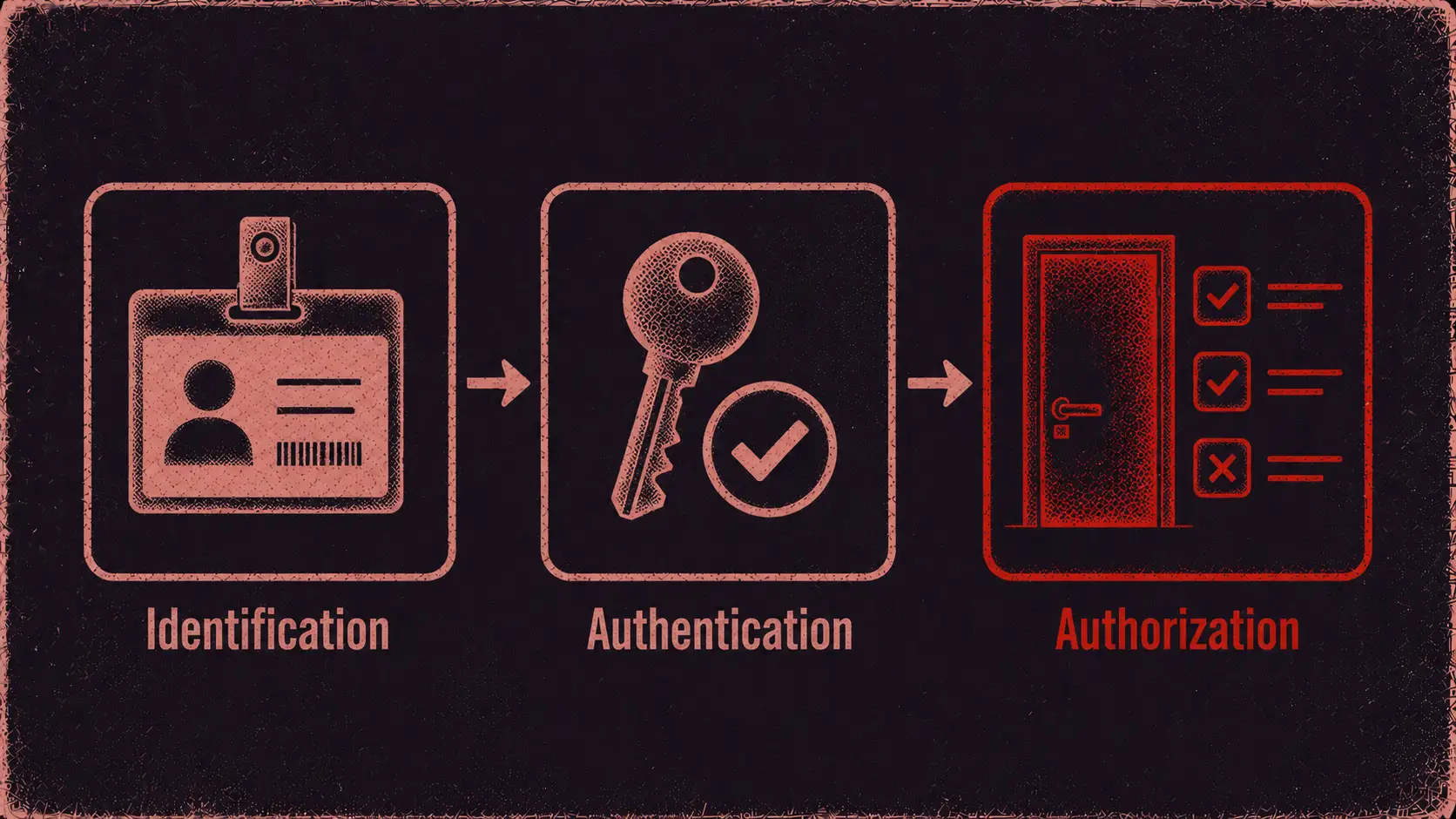
Identification is the claim of identity — the user asserting who they are. Usually this takes the form of a username, email address, or employee ID.
Authentication is the verification of that claim. It answers the question: is the person making the request actually who they say they are? Authentication is done by requiring the user to prove they possess one or more factors: something they know (password), something they have (a security key), or something they are (a biometric).
Authorization is the decision about what the authenticated user is allowed to do. Even after a user is identified and authenticated, the system must still decide which resources they can access and which actions they can take. Authorization models range from simple role-based access control (RBAC) to fine-grained attribute-based access control (ABAC).
An IAM system that gets any of these three wrong creates opportunity for compromise. Weak authentication lets attackers become users. Excessive authorization lets legitimate users — or attackers who have compromised them — do far more damage than their role requires.
Common IAM Attacks and Weaknesses
The threats against IAM systems fall into a handful of recognizable patterns.
- Credential theft — attackers steal usernames and passwords through phishing, malware, or data breaches, then reuse them to log in as legitimate users. See our guide to credential stuffing attacks for how leaked credentials become widespread compromise.
- Account takeover — the successful hijack of a legitimate user's account, giving the attacker whatever access that user had. Our guide to account takeover covers detection and prevention.
- Phishing and social engineering — tricking users into handing over credentials or approving fraudulent authentication requests. Our essential guide to phishing covers the major variants.
- MFA bypass — techniques attackers use to defeat multi-factor authentication once they have a password. Our guide to MFA bypass attacks explores the most common approaches.
- Privilege escalation — turning a low-privilege foothold into administrative control. See our explainer on privilege escalation for details.
- Insider misuse — legitimate users with legitimate access who misuse it, intentionally or accidentally.
What unites these attacks is that they bypass most technical defenses by targeting identity itself. IAM controls exist to raise the cost of each of them.
Multi-Factor Authentication (MFA)
Multi-factor authentication requires a user to prove their identity with two or more independent factors before authentication succeeds. Even if an attacker steals a password, they cannot log in without also providing the second factor.
MFA is the single highest-impact IAM control an organization can deploy. It shuts down the majority of credential-stuffing and phishing attacks that would otherwise succeed. Not all MFA is equally strong — SMS codes are weaker than authenticator apps, which are weaker than phishing-resistant methods like FIDO2 security keys — but almost any MFA is better than none. Our full guide explains what multi-factor authentication is.
Single Sign-On (SSO)
Single sign-on lets a user authenticate once and access many connected applications without re-entering credentials. SSO is often mischaracterized as a convenience feature — and it is one — but its security value is at least as significant.
Consolidating authentication into a single point means fewer passwords for users to manage, fewer login flows for attackers to phish, and one central place to enforce MFA and monitor authentication activity. Done well, SSO makes IAM stronger, not weaker. Done poorly, it makes the SSO provider a single point of failure — which is why the choice of SSO provider is itself a security decision. See our guide to single sign-on (SSO).
Privileged Access Management (PAM)
Not all accounts are equal. Domain administrators, cloud root accounts, database superusers, and service accounts with broad permissions represent disproportionate risk — if one is compromised, an attacker can do enormous damage in a single stroke. Protecting these accounts is central to cloud security.
Privileged access management is the set of practices and tools that treat these high-privilege accounts as their own security category. PAM programs typically vault privileged credentials, rotate them frequently, record sessions using them, and grant elevated access only just-in-time — for the duration of a specific task — rather than persistently.
The Rise of Zero Trust
The traditional model of network security assumed that anything inside the corporate perimeter was trusted, and anything outside was not. That assumption has quietly collapsed. Remote work, cloud infrastructure, contractor access, and lateral movement inside compromised networks all demonstrate the same lesson: trust cannot be based on location.
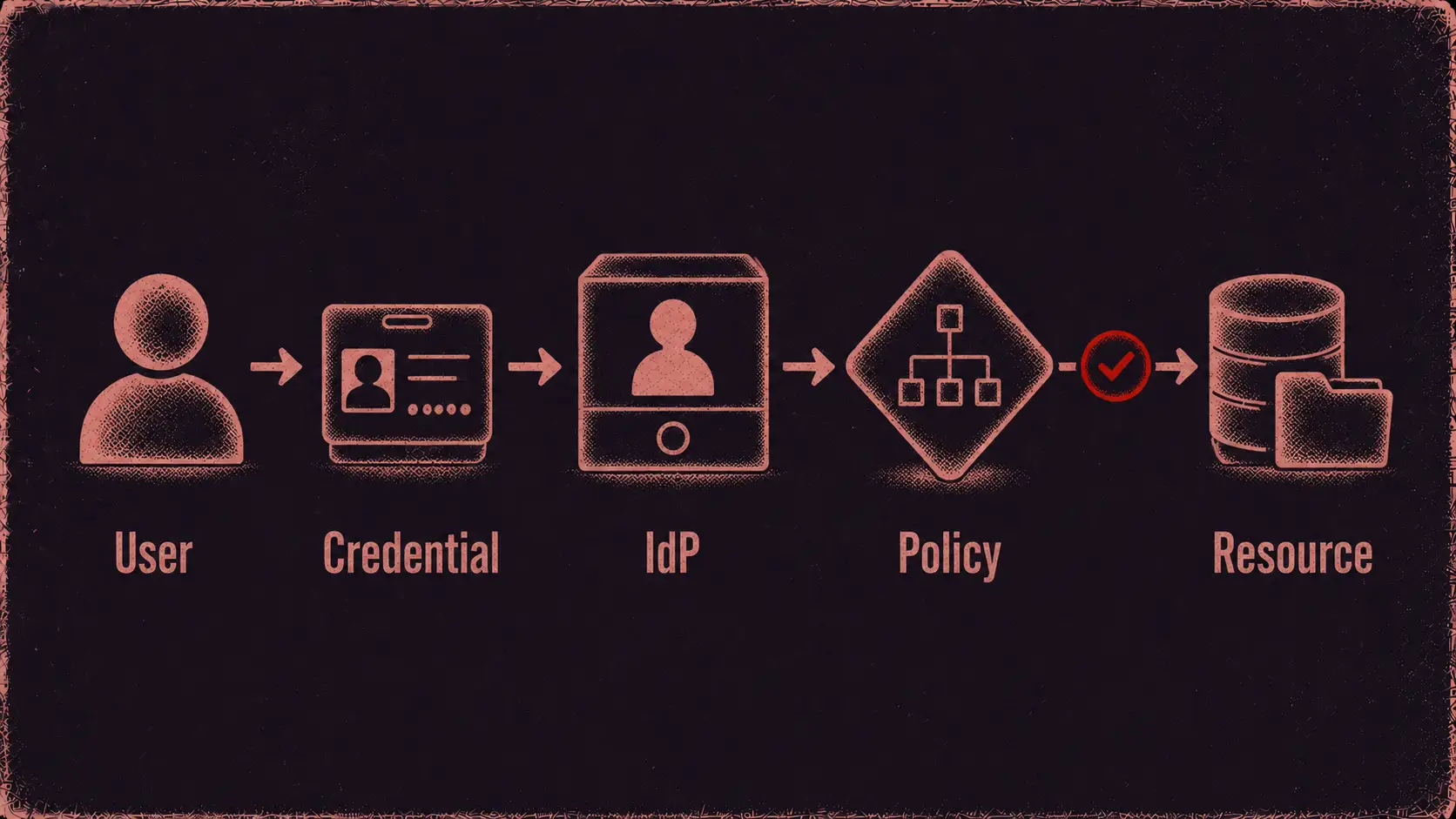
Zero trust is the architectural response. Rather than trusting anything by default, zero trust requires every access request to be verified explicitly — authenticating the user, checking the device, evaluating context, and applying least-privilege authorization — every time. Identity becomes the primary control plane in a zero trust architecture, which is why IAM sits at the center of it.
Building an IAM Program
Standing up a serious IAM program is a multi-year effort for most organizations. Our step-by-step IAM implementation guide covers the full sequence phase by phase — from discovery through governance. The priorities below recur across most successful programs:
- Inventory your identities. Know which humans, services, and non-human identities exist and what they can access. Coverage gaps are blind spots.
- Enforce MFA universally. Every account that supports it should require MFA — ideally phishing-resistant. This is the single highest-return investment in identity security.
- Centralize authentication. Use SSO to consolidate login into a single trusted flow with strong MFA and central logging.
- Apply least privilege. Grant the minimum access a user needs to do their job. Review and revoke unused permissions regularly.
- Separate and monitor privileged access. Treat privileged accounts as a distinct category with vaulting, session recording, and just-in-time elevation.
- Automate the lifecycle. Provisioning and, especially, deprovisioning should be automated. Orphaned accounts are one of the most consistent sources of long-lived compromise.
- Monitor for abuse. Anomalous login times, impossible travel, unusual privilege use, and failed authentications are early signals of account compromise.
Conclusion
IAM is not a product you buy or a project you finish. It is a continuous discipline that touches every user, every system, and every access decision in the organization. Done well, it prevents most of the attacks that actually cause breaches today. Done poorly, it becomes the fastest path in for attackers who have learned that identity is easier to steal than security is to break.
The organizations that get IAM right treat identity as the foundational security boundary — investing in strong authentication, centralizing access decisions, restricting privileges, and monitoring for abuse. In an era where the perimeter has dissolved, identity is what remains.
Frequently Asked Questions (FAQ)
What is identity and access management (IAM)?
IAM is the discipline of ensuring the right people have the right access to the right systems at the right time — and that nobody else does. It covers the full lifecycle of digital identity, from creation through authentication and authorization to retirement.
What are the three pillars of IAM?
Identification (claiming an identity), authentication (verifying the claim), and authorization (deciding what the authenticated user is allowed to do). Every access decision in an IAM system runs through these three operations.
What is the difference between authentication and authorization?
Authentication verifies who the user is; authorization decides what that user is allowed to do. Both are necessary — a system that gets either wrong is not secure.
Why is IAM so important?
Stolen and misused credentials are now the most common cause of data breaches. Attackers who become legitimate users bypass most technical defenses, which is why IAM has become a first-order security discipline rather than a background IT function.
What is the highest-impact IAM control?
Multi-factor authentication, applied universally, shuts down the majority of credential-based attacks. Phishing-resistant MFA (such as FIDO2 security keys) is stronger than SMS-based MFA, but any MFA is dramatically better than none.
What is zero trust and how does it relate to IAM?
Zero trust is an architectural model that requires every access request to be verified explicitly, rather than trusting anything by default. Identity is the primary control plane in a zero trust architecture, which puts IAM at the center of the modern security stack.