Suspected Iran-Linked Hackers Shut a UK Power Plant for Four Days: A CNI Wake-Up Call
A suspected Iran-linked cyberattack kept a small UK power plant offline for four days in July 2026, the same month more than 30 US water utilities were hit. The government says the wider grid was never at risk. Here is what defenders should verify.

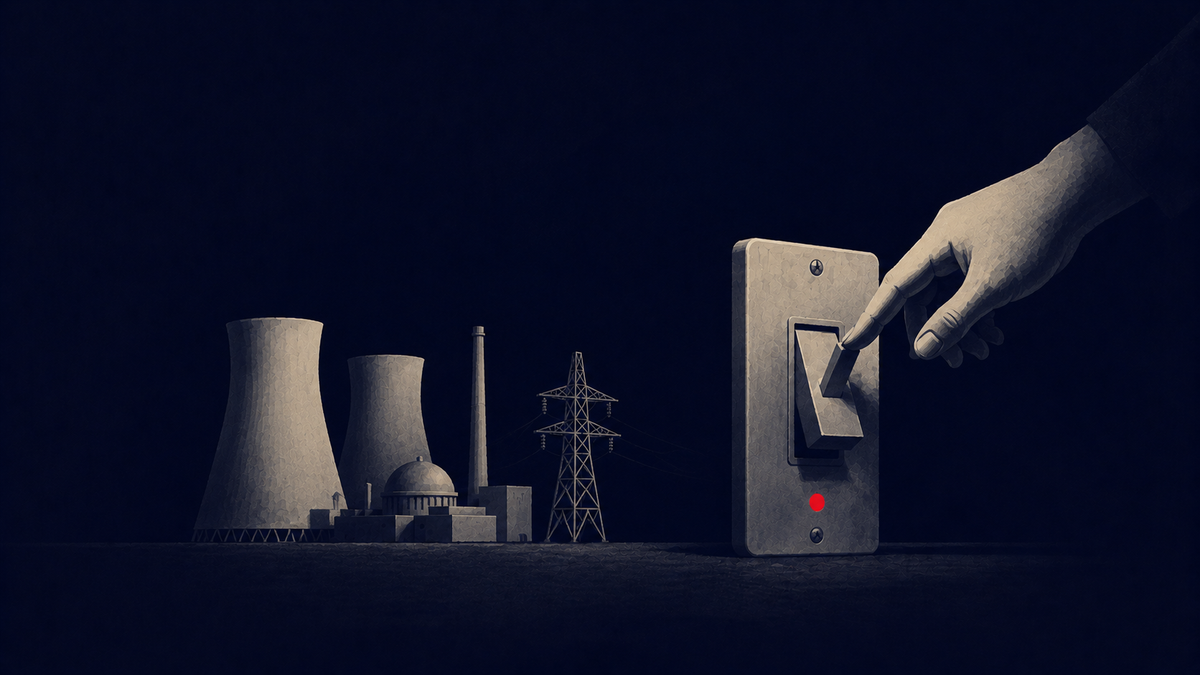
LONDON. A suspected Iran-linked cyberattack kept a small British power plant offline for four days in July 2026, in what is being described as the first disruptive cyber incident of its kind to strike UK energy infrastructure. The story was first reported by The Telegraph over the weekend and picked up on August 24 by The Register, SecurityWeek, Help Net Security and Infosecurity Magazine.
The single number doing the work here is four. Not the size of the plant, which was small enough that the outage barely registered on the grid, but the four days it took to restore. For anyone responsible for critical national infrastructure (CNI), that recovery window is the story: a cyber incident turned into four days of real-world operational disruption, and the public still does not know why.
This piece does two things the wire coverage does not: it separates what the UK government has actually confirmed from what remains unconfirmed and is being inferred, and it turns the episode into a short, concrete verification checklist for energy and water operators. We do not reconstruct how the plant was breached, because no one has disclosed it, and because that is not what defenders need from this story.
What the UK Government Confirmed
A British government spokesperson confirmed the incident to The Register and framed it narrowly. The affected site was a "small-scale energy generator," the spokesperson said, adding: "At no point was there a risk to the wider energy system." The government called the UK energy system "highly resilient" and said it works closely with the sector to protect infrastructure.
Michael Shanks, Minister of State in the Department for Energy Security and Net Zero, said his department briefed energy chief executives after the incident and, in his words, "shared further advice with companies on the steps they should take to stay secure," per Help Net Security. He tied the response to the Energy Resilience and Security Taskforce he chairs. That is the confirmed core: an incident happened, it hit one small generator, the wider grid was not affected, and the government engaged operators directly.
What Has Not Been Confirmed
Almost everything else is unconfirmed or single-sourced, and defenders should hold it loosely. The government has not named the plant or its location. It has not formally attributed the attack to Iran, or to any government or hacking group. The "Iran-linked" and "suspected Iranian" framing comes from The Telegraph's sources and from private-sector analysts, not from an official UK attribution.
Crucially, no one has publicly disclosed how the intrusion happened. There is no confirmed initial-access vector, and no public confirmation of whether operators lost control of the plant's process systems or whether a safety mechanism triggered a protective shutdown. Those are very different failure modes with very different lessons, and the reporting does not resolve which occurred. As former GCHQ adviser James Griffiths told Help Net Security, "nothing has been released about how this happened," which is exactly why the four-day recovery is drawing the questions.
The reporting also says the incident was reported to the National Cyber Security Centre (NCSC), but the NCSC has issued no public advisory or statement, and there is no confirmed role for the energy regulator Ofgem in the response. Treat the NCSC-notification detail as reported, not as an official record. No specific US water utilities have been named in connection with the parallel campaign either.
The Water-Sector Parallel
The UK outage did not happen in isolation. It coincided with a wave of intrusions against US water systems. In late July, suspected Iranian operators disrupted more than 30 community water utilities in Minnesota, with similar activity subsequently reported across at least 11 other US states. Infosecurity Magazine put the spread at 12 states, describing intrusions into programmable logic controllers (PLCs) across government, water and wastewater, and energy sectors.
That thread matters because it is the same class of target. Just days before the UK news broke, US agencies warned that attackers were using AI-generated exploitation scripts against internet-exposed Siemens S7 PLCs at water, energy, and manufacturing facilities, and CISA had already flagged Iran-linked disruption of US water and energy providers targeting Siemens and Schneider industrial gear. The common denominator is internet-reachable operational technology in the hands of smaller operators. "This appears to be a continuation of the same suite of activity we suspect is affiliated with Iran targeting PLCs," Cynthia Kaiser of the Halcyon Ransomware Research Center, a former FBI cyber analyst, told The Register.
Why Four Days Is the Number That Matters
Security professionals reacting to the disclosure landed on the same point: the facility's size is not the concern, the operational impact and the recovery time are. "The significance isn't the size of the facility, but that a cyberattack turned into four days of real-world operational disruption," said Muhammad Yahya Patel, an EMEA cybersecurity adviser at Huntress, in SecurityWeek. "Why did recovery take four days, and are smaller operators adequately prepared to contain and recover from these incidents?"
Phil Tonkin, field CTO at OT security firm Dragos, warned that the more dangerous property of an incident like this is repeatability: the loss of a single small facility can be managed, but "these are often very repeatable attacks that could be deployed at scale." Griffiths called the episode a wake-up call for the wider CNI community, and Infosecurity Magazine noted the visibility gap Patel raised, that smaller energy operators falling below mandatory reporting thresholds could hide how often this part of the sector is being probed or hit.
The defensive read is not that a small generator went dark. It is that a distributed fleet of small operators, individually unremarkable and collectively load-bearing, is now a demonstrated target, and that recovery, not just prevention, is where several of them may be underprepared.
My read: This is an assessment, not a reported fact. The absence of an official attribution and the absence of any technical detail are being read as caution, and I think that is right, but it also means the loudest lesson available is the four-day recovery, not the intrusion. If I ran a small energy or water operator, I would not wait for attribution or a root-cause writeup. The repeatable, low-sophistication pattern already visible in the US water sector is a good enough planning assumption to act on now, and the honest question to ask internally is not "could we be breached" but "how fast could we get back."
What CNI and Water Operators Should Verify Now
None of the following depends on knowing how the UK plant was breached. Each item is something an energy or water operator can confirm this week, and each maps to the pattern regulators and analysts have already described for Iran-nexus targeting of operational technology.
● CNI Defender Verification Checklist Five things energy and water operators can confirm this week, no attack detail required. |
1 → OT / IT Segmentation Confirm the control network cannot be reached from the business network or the public internet. Test the rules, don’t assume them. |
2 → Remote Access Inventory + MFA List every remote path into OT, including vendor and maintenance access. Enforce multi-factor authentication, and remove any route you cannot account for. |
3 → Advisory Review: CISA + NCSC Read the current CISA and NCSC guidance on Iran-nexus targeting of internet-exposed PLCs, and check your Siemens and Schneider assets against it. |
4 → Manual-Operation Fallback Confirm the plant can run on manual control if digital systems are isolated, and that staff have recently practised doing it. |
5 → Incident Response + Recovery Drill Time your restore-from-clean-state, not just your detection. The UK lesson is the four-day recovery, so rehearse the recovery. |
● Escalation Trigger If any answer above is "we are not sure," treat it as an active exposure, not a paperwork gap, and escalate it now. |
Source: The CyberSignal, drawn from public CISA and NCSC guidance on Iran-nexus targeting of operational technology. Defender checklist only, no attack detail. |
A verification checklist for CNI and water operators, built from public CISA and NCSC guidance. It describes defensive checks only. Source: The CyberSignal.
The water-sector wave gives this a sharper edge. If the same low-effort, repeatable playbook that hit dozens of US utilities is now reaching UK energy, the operators most at risk are precisely the small ones least likely to have rehearsed a four-day outage. Dan Bird, EMEA field CTO at Horizon3.ai, put the priority plainly in Help Net Security: find the exploitable gaps before an adversary does, and confirm whether known weaknesses actually create a usable attack path before assuming they do not.
Britain Was Always on the List
None of this should have caught London off guard. In July 2025, the UK's Intelligence and Security Committee (ISC) warned that Iran posed a significant cyber threat, singling out petrochemical, utilities, and finance as the likeliest disruption targets. The committee judged that the UK was “not a top priority for Iranian offensive cyber activity,” but added that this “could change rapidly in response to regional or geopolitical developments,” as Infosecurity Magazine noted.
That change looks to have arrived. Since the summer's conflict, Iran-affiliated groups have struck targets across the US, Israel, the Gulf states, and Europe, which makes an early BBC characterisation of “little activity so far” hard to sustain, as SecurityWeek argued. A former GCHQ adviser called the UK breach “unfortunately inevitable,” pointing to years of under-investment in protecting ageing CNI systems that run the power most people never think about.
The timing also lands inside a regulatory gap. The UK's Cyber Security and Resilience Bill, which would force essential-service and digital providers to harden their defences, is still moving through Parliament and is not expected to take full effect for some years, per Help Net Security. Until it does, smaller generators that fall below mandatory cyber-reporting thresholds can keep dropping out of the national picture. If regulators cannot see how often small operators are being hit, the operators cannot learn from one another either, which is the visibility gap analysts kept returning to.
The Bottom Line
Strip away the unconfirmed attribution and the missing technical detail, and a defensible summary remains. A small UK generator was knocked offline for four days by an attack widely suspected to be Iran-linked, at the same time a coordinated campaign hit more than 30 US community water utilities. The UK government says the wider grid was never at risk, and there is no reason to doubt that. But the value of this disclosure for defenders is not the intrusion. It is the reminder that recovery time is a security metric, that small operators are in scope, and that the checklist above is worth running before the next one is not so small.
Updated August 24, 2026: This is a developing story. We will update if the UK government confirms attribution, names the facility, or the NCSC publishes formal guidance.
Primary Documents
- The Register: Iran-linked cyberattack shut down a UK power plant (government confirmation and quote)
- SecurityWeek: Iran-Linked Hackers Shut Down UK Power Plant for Four Days
- Help Net Security: Suspected Iran-linked attack knocked UK power plant offline for days
- Infosecurity Magazine: Wake-Up Call for CNI After Iranian Attack Shuts Down UK Power Plant
- The Telegraph: original report (paywalled)