Unit 42 Publishes “Three Steps to the Terminal” Analysis of Chained Siemens ROX II Zero-Day Vulnerabilities
Three chained OT zero-days in Siemens ROX II — a defender review for industrial operators this week, with Unit 42's analysis and Siemens's fixed firmware as the anchors.

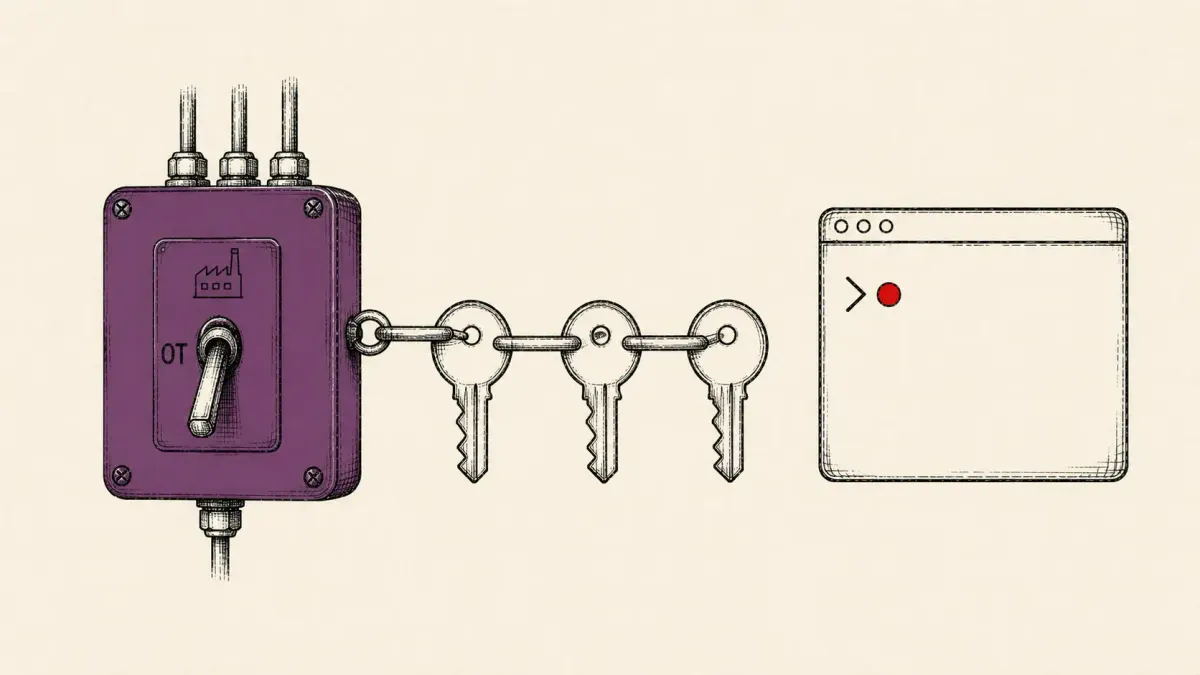
A vendor-and-researcher partnership turns a chained OT-switch flaw into a scheduled patch-verification exercise — the defender question is coverage, not chain reconstruction.
SANTA CLARA, CALIF. — Palo Alto Networks' Unit 42 on July 17, 2026 published a technical analysis of three chained zero-day vulnerabilities in Siemens Ruggedcom ROX II operational-technology (OT) switches, titled “Three Steps to the Terminal: A Siemens ROX II Zero-Day Trilogy.” According to Unit 42, the three flaws — tracked as CVE-2025-40948, CVE-2025-40947, and CVE-2025-40949 — can be chained to move from initial reconnaissance to full privilege escalation and persistent root access on switches that sit at the heart of industrial control networks. The research was conducted in partnership with Siemens ProductCERT under coordinated disclosure, and Siemens has issued advisories with a fixed firmware version.
For teams that defend OT and industrial environments, the relevant framing is not the exploit chain but the response window it opens. The vendor and the researchers disclosed together, patches exist, and the work in front of operators is the familiar one: identify whether ROX II switches are in the estate, confirm firmware, and verify coverage against the primary advisories rather than assume it. The CyberSignal does not reconstruct the chain here, and none of the technical detail below is a how-to — it is drawn from Unit 42's published report and Siemens's own advisories to help defenders scope their exposure.
What Unit 42 Documented
Unit 42 — the threat-research group at Palo Alto Networks — describes three distinct zero-day vulnerabilities in the Siemens Ruggedcom ROX II switch operating system that, taken together, form a single chain. At a high level and in the group's own terms, the first flaw (CVE-2025-40948) is an arbitrary file disclosure issue that could reveal sensitive files such as configuration data, password hashes, and cryptographic material; the second (CVE-2025-40947) is a command-injection weakness in the device's feature-key validation logic that could yield root-level command execution; and the third (CVE-2025-40949) is an input-sanitization flaw in the switch's web-management task scheduler that could establish code execution surviving a reboot. Unit 42 assigns CVSS 3.1 scores of 6.8, 7.5, and 9.1 to the three, ranging from medium to critical severity.
Unit 42's stated conclusion is that, chained, the vulnerabilities could turn a network-security device into a platform for persistent root access on an industrial network. The CyberSignal is deliberately not reproducing the group's proof-of-concept, payloads, or step-by-step exploitation detail; the material below is scoped to what a defender needs to determine exposure and prioritize remediation. The report also underscores a point OT teams know well but that bears repeating: a switch that is air-gapped or sits on an isolated segment is not inherently immune to software flaws, and OT switches are as susceptible to vulnerabilities as any other networked equipment.
The framing matters. This is defender-oriented vendor research published under coordinated disclosure, not a report of an in-the-wild campaign. Unit 42 names no threat actor, describes no observed exploitation, and pairs the analysis with detection and mitigation guidance. The CyberSignal likewise attributes no activity to any group and treats the disclosure as a patch-and-verify event rather than an active-incident one.
Continuation Context: The ICS Patch Tuesday Thread and the OT-Security Beat
This disclosure lands days after the July 2026 industrial-control-systems cycle The CyberSignal covered in our ICS Patch Tuesday roundup of Siemens, Schneider Electric, and Rockwell advisories, and it fits the same operational rhythm. Where the monthly cycle is a scheduled synchronization point, a coordinated single-product disclosure like this one is an out-of-band item that operators fold into the same triage discipline: reconcile against the asset inventory, rank by severity and exposure, and validate the fix. The ROX II trilogy is a reminder that vendor advisories arrive on their own schedules, and a complete picture requires monitoring each vendor's security feed continuously rather than only on Patch Tuesday.
It also sits within a broader OT-security beat The CyberSignal has tracked closely. We have covered warnings that hostile states are probing critical national infrastructure and earlier CISA guidance on exposed industrial monitoring systems. Against that backdrop, a coordinated disclosure that arrives with patches already available is close to a best case: operators get the vulnerability detail and the remediation path at the same moment, and the controllable variable is how quickly and completely they act on it.
Defender Posture for OT Environments Running Siemens ROX II
For operators that run Ruggedcom ROX II, the posture is methodical rather than dramatic. The first step is reconciliation: confirm whether any ROX II switches are deployed and, if so, on what firmware, because the entire question of exposure turns on whether devices are running a version before V2.17.1. General patch-management and vulnerability-management discipline applies, but the OT context raises the stakes on sequencing and testing, where change windows are tied to production schedules and reboots cannot be arbitrary.
From there, the work is risk-based prioritization anchored on the primary sources. Operators running affected devices should treat the update to firmware V2.17.1 as the durable remediation and verify it against Siemens's own advisories and build data rather than a secondary summary. Because the highest-severity flaw in the chain concerns persistence and root-level control, devices reachable from enterprise networks or remote-access paths warrant the front of the queue. While patches move through OT validation, the standard compensating controls carry the load: tight network segmentation, restricted and monitored remote access to management interfaces, and detection for the anomalous behaviors the vendor describes.
Unit 42 also frames virtual patching — network-layer detection that blocks exploitation attempts before they reach a vulnerable device — as an interim compensating control for environments that need time to test and deploy firmware. That is consistent with defense-in-depth for OT: firmware updates remain the long-term fix, but layered controls reduce exposure during the validation window. For defenders, the takeaway is that this disclosure is one of the more controllable variables in a pressured environment: operators cannot choose when flaws surface, but they can choose how quickly they verify firmware and confirm that segmentation and monitoring remain in place.
Siemens's Response and What to Watch For
Siemens participated in the research through Siemens ProductCERT and has published security advisories — SSA-973901, SSA-078743, and SSA-081142 — that direct customers to update affected ROX II devices to firmware version V2.17.1. The coordinated model here is the notable operational feature: rather than a public disclosure racing an available fix, the vendor advisory, the researcher analysis, and the remediation all arrived together, which shortens the interval in which operators are aware of a flaw but lack a path to close it.
What defenders should watch for next is status change rather than new technical detail. The reviewed material describes no active exploitation, but that is a point-in-time observation, not a guarantee; operators should monitor CISA's Known Exploited Vulnerabilities catalog and Siemens's advisory feed for any update. It is also worth tracking whether CISA issues an ICS advisory echoing the Siemens advisories through its own channel, as it commonly does for widely deployed industrial products — a second authoritative source that many operators find easier to monitor than individual vendor feeds. Neither of those was confirmed in the material reviewed for this article at publication.
Open Questions
Several specifics sit outside the scope of this coverage and should be checked against the primary advisories before being treated as settled for a given estate. The precise affected build ranges, the full list of ROX II hardware variants in scope, and any model-specific caveats are enumerated in Siemens's advisories, not in a summary, and operators verifying their own exposure should work from those authoritative documents. The CVSS scores cited here are Unit 42's CVSS 3.1 values; an operator's environmental score may differ based on deployment and exposure.
On exploitation, the reporting reviewed for this article does not describe any of the three vulnerabilities as being exploited in the wild, and The CyberSignal does not assert that any are. No threat actor is named in connection with this research, and The CyberSignal attributes no activity to any group. Whether CISA publishes a parallel ICS advisory, and whether any exploitation is later observed, are the two status questions most worth tracking.
The larger open question is cadence. As AI-assisted research compresses the interval between disclosure and exploitation — a dynamic the vendor itself flags — the operative uncertainty for industrial defenders is whether OT validation and patch pipelines can move quickly enough to stay ahead of it. That is answered over successive disclosures, not in any single one.
The CyberSignal Analysis
The facts above are drawn from Unit 42's published report and Siemens's advisories; what follows is The CyberSignal's editorial reading of what OT defenders should take from them. None of the judgments below are new reported facts, and none reconstruct the exploit chain.
Signal 01 — Coordinated Disclosure Is the Story, Not the Chain
The headline detail — three chained zero-days ending in persistent root access on an OT switch — is arresting, but the operationally important fact is that the vulnerability analysis and the fix arrived together. A vendor-and-researcher partnership that publishes under coordinated disclosure collapses the most dangerous interval in any vulnerability's life: the window in which defenders know a flaw exists but have no supported way to remediate it. Our reading is that this is the model OT operators should want to see more of, because it converts a potential crisis into a scheduled maintenance item.
The corollary is that defenders should resist treating a dramatic chain description as an emergency signal in itself. There is no reported exploitation, a patched firmware exists, and the researchers withheld a full repro. The disciplined response is to scope, patch, and verify — not to over-rotate on the narrative of a three-step compromise that, in practice, reduces to a firmware-version check for most estates.
Signal 02 — “Isolated” OT Devices Still Need a Patch Program
Unit 42 makes a point that defenders internalize slowly: an OT switch that is air-gapped or segmented is not immune to software vulnerabilities. Segmentation limits who can reach a device; it does not remove the flaw, and it fails the moment an assumption about isolation turns out to be wrong — a misconfigured jump host, a forgotten remote-access path, or a flat management VLAN. Our assessment is that the enduring lesson of this trilogy is not the specific flaws but the reminder that isolation is a compensating control, not a substitute for patching.
That reframes where the value lies. The organizations best positioned here are the ones that already maintain an OT asset inventory precise enough to answer “do we run ROX II, and on what firmware” in minutes, and that treat segmentation and firmware updates as layered defenses rather than alternatives. The ones that lean entirely on presumed isolation are the ones a chained flaw like this is designed to surprise.
Signal 03 — Compensating Controls Buy Time; Firmware Closes the Gap
The vendor's own guidance — apply firmware, and use virtual patching as an interim control — maps cleanly onto OT reality, where validation and change windows can stretch for weeks. Our judgment is that operators should take both halves seriously: network-layer detection and tightened remote access materially reduce exposure during the validation window, but they are a bridge, not a destination. The gap only truly closes when V2.17.1 is deployed and verified.
The forward implication is structural. As the vendor notes, AI is compressing the time between disclosure and exploitation, which raises the cost of a slow validation pipeline. The operators who come through cleanly will be those whose OT patch programs are built to sequence critical, network-reachable fixes on an expedited validated track while compensating controls hold the line — a posture that is decided long before any single advisory lands.



