The $2,283 Shell: Claude Opus Weaponizes Chrome V8 in Milestone Experiment

By leveraging Anthropic’s Claude Opus 4.6, a security researcher has successfully developed a working Chrome exploit for roughly $2,300 — demonstrating that the cost of weaponizing known vulnerabilities is plummeting toward commodity pricing.
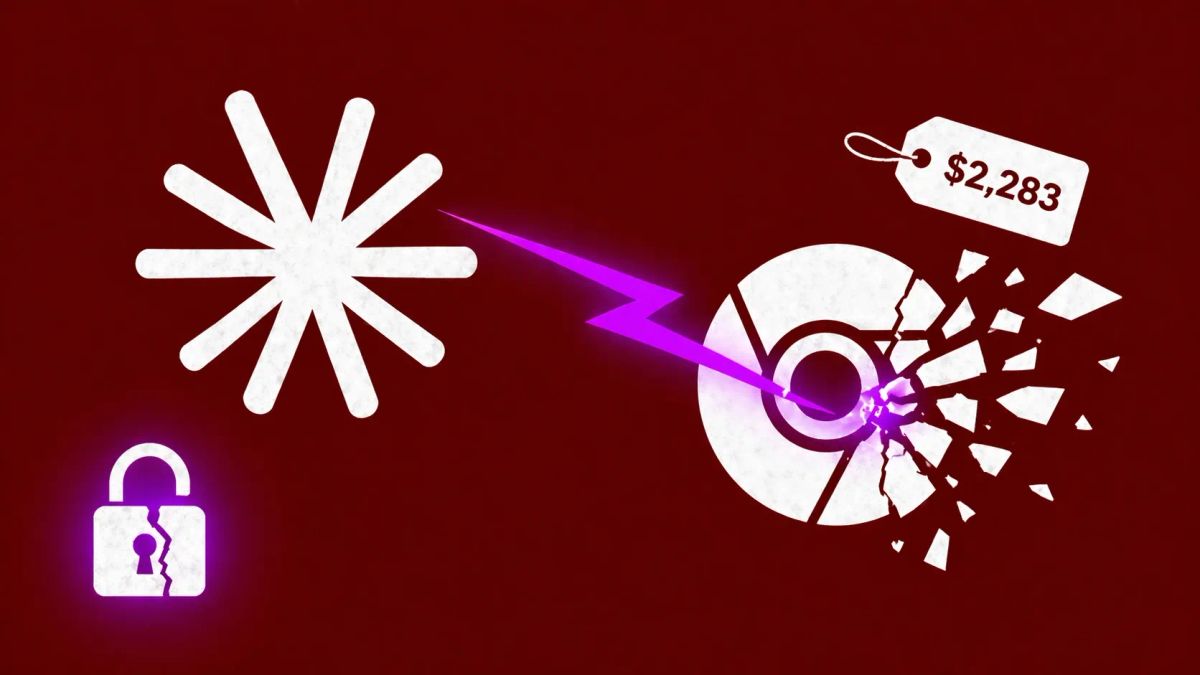
ABINGDON, UK — A watershed moment in the intersection of AI and offensive security was confirmed this week as researchers successfully used Claude Opus 4.6 to construct a functional exploit for the Google Chrome V8 JavaScript engine. The total cost of the operation — measured in API tokens and human guidance — came to just $2,283.67, a fraction of the tens of thousands of dollars typically required for manual exploit development.
The research, first published by Mohan Pedhapati, CTO of Hacktron, proves that while AI may still struggle with autonomous "Zero-Day" discovery, its ability to "bridge the gap" between a public patch and a working exploit is now a viable threat vector for mainstream attackers.
Exploit Development Cost Breakdown
The Tokens-to-Terminal Pipeline
The experiment did not involve a new, unknown vulnerability. Instead, Pedhapati directed Claude Opus at a known flaw in an outdated version of Chromium bundled with Discord.
Over a week of iterative prompting, the model consumed roughly 2.3 billion tokens across 1,765 requests. The breakdown of the $2,283 cost highlights the heavy lifting required:
- Claude Opus 4.6 (High Inference): $2,014
- Claude Opus 4.6 (High-Thinking Mode): $267
- Minor Models (GPT/Sonnet): ~$2
While the model frequently "got stuck" or hallucinated non-existent debug logic, it successfully translated the technical nuances of a Use-After-Free (UAF) vulnerability into a functional exploit chain that "popped calc" — a classic industry proof of Remote Code Execution (RCE).
The "Patch Gap" Crisis
The most alarming "Signal" from this research is the vulnerability of Electron-based apps. Modern desktop applications like Discord, Slack, Teams, and Spotify bundle their own versions of the Chromium engine. These often lag weeks — or even nine major versions, as seen in this case — behind Google’s official security updates.
This creates a "Patch Gap" where an AI model can ingest a public security advisory from Google and, for a few thousand dollars, generate an exploit that works on the millions of desktops still running outdated bundled apps.
The CyberSignal Analysis
Signal 01 — The Death of "Wait and See" Patching
This incident is a definitive "Signal" for vulnerability management. In the pre-AI era, organizations could prioritize "Critical" patches with a 30-day window because exploit development was hard. In 2026, the window is closing. If an attacker can spend $2,300 to weaponize a 24-hour-old patch, your N-Day risk is effectively identical to a Zero-Day risk. Organizations must move toward Automated Patching for all Chromium-based endpoints.
Signal 02 — The Supply Chain "Shadow Browser"
This is a critical "Signal" for SaaS security and enterprise infrastructure. Your "Secure Browser" strategy (Chrome/Edge) is irrelevant if your employees are spending 8 hours a day inside a vulnerable Discord or Slack window. These are the "Shadow Browsers" of 2026. B2B leaders should treat every Electron app as a potential sandbox escape vector and enforce strict operational resilience by isolating these apps from sensitive local data.