Conduent Data Breach Expands to Tens of Millions of Americans


A major data breach involving government technology contractor Conduent is continuing to grow in scope, with investigations now indicating that more than 25 million Americans may have had sensitive personal data exposed. The incident, which stems from a cyber intrusion discovered in early 2025, has become one of the largest breaches affecting U.S. government service infrastructure in recent years.
Conduent, a business process and technology services provider headquartered in New Jersey, works behind the scenes for numerous government agencies and private organizations. The company manages systems tied to healthcare programs, social services, transportation payments, and other public-sector operations. Because of this role, it processes vast quantities of personal information belonging to millions of individuals across multiple states.
Initially, breach notifications suggested that roughly 10 million people may have been affected. However, as forensic investigations progressed and more agencies reviewed their records, the estimated impact expanded significantly. Updated figures from state disclosures and regulatory filings now indicate that the number of affected individuals could exceed 25 million nationwide, though investigators say the final total may continue to change as additional data sets are analyzed.
The breach has triggered regulatory scrutiny, class-action lawsuits, and widespread concern among cybersecurity professionals. Experts say the incident underscores the growing risk posed by attacks on large third-party technology providers that manage critical government systems and sensitive citizen data.
Attack Origin and Timeline
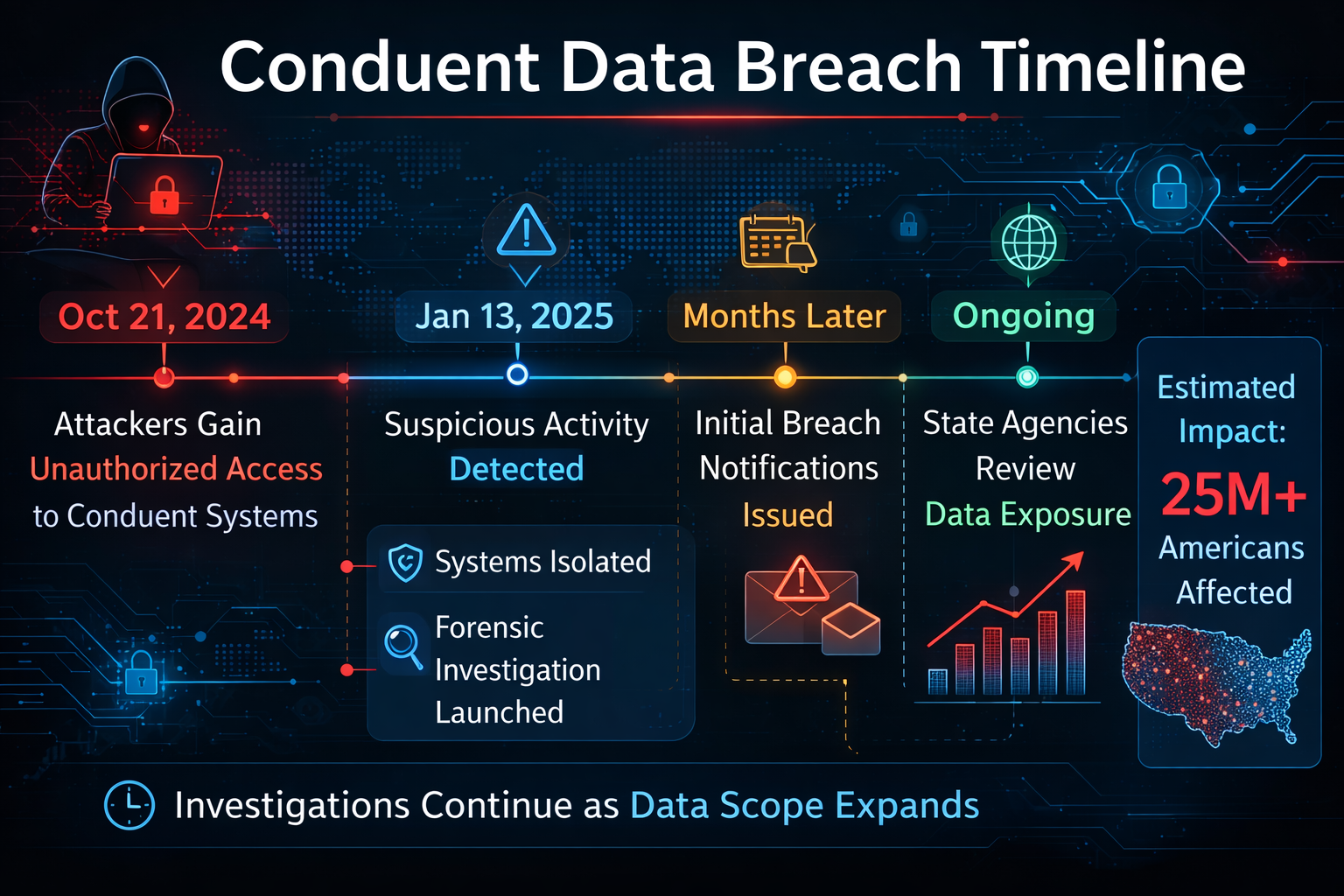
According to investigative findings and public disclosures, attackers gained unauthorized access to Conduent’s systems between October 21, 2024 and January 13, 2025. During this period, threat actors were able to access internal systems before the intrusion was detected.
The company reported discovering suspicious activity on January 13, 2025 and subsequently began containment measures, including isolating affected systems and launching a forensic investigation with external cybersecurity experts.
Initial breach notifications were issued months later as investigators worked to determine exactly what data had been accessed and which clients were impacted. As additional state agencies reviewed the data exposure tied to their systems, the number of potentially affected individuals continued to increase.
Cybersecurity analysts say incidents like this often take months to fully understand due to the complexity of shared infrastructure and the large volumes of historical data maintained by service providers.
Sensitive Data Potentially Exposed
The types of compromised information vary depending on the program or agency involved. However, breach notifications indicate that several categories of highly sensitive personal data may have been exposed.

Reportedly compromised data may include:
- Full names
- Physical addresses
- Social Security numbers
- Dates of birth
- Health insurance information
- Medical records or claims data
Security experts warn that this type of combined information can be particularly valuable to cybercriminals because it can enable identity theft, financial fraud, and medical identity fraud.
In cases where multiple identifiers were exposed together—such as Social Security numbers paired with names and birthdates—the risk of long-term identity misuse increases significantly.
Disproportionate Impact in Several States
Although the breach affects individuals nationwide, several states appear to have been disproportionately impacted.
Texas officials have reported that approximately 15.4 million residents may have been affected, representing nearly half of the state’s population. Investigators believe this large number is tied to the scale of data managed through government service programs connected to Conduent systems.
Oregon officials have also reported a significant exposure, estimating that around 10.5 million individuals may have had data compromised through systems connected to state programs.
Additional smaller exposures have been reported in states including Massachusetts, New Hampshire, and Delaware.
Investigators note that some individuals may appear in multiple datasets due to participation in different programs or historical record retention, which may explain why reported exposure numbers can exceed the current population of certain states.
Why the Incident Is So Significant
Conduent plays a major role in managing digital infrastructure for government and enterprise clients. The company provides backend services that support numerous essential programs, including:
- Medicaid and healthcare administration
- unemployment insurance systems
- food assistance and benefits programs
- electronic toll collection and transportation payment systems
Because these services involve large populations and sensitive personal information, attacks against companies like Conduent can have wide-reaching consequences.
Cybersecurity experts often describe these incidents as “supply chain data breaches”—where a single compromised vendor exposes data tied to many organizations simultaneously.
This model allows attackers to obtain vast amounts of information through a single intrusion point rather than targeting individual agencies or organizations separately.
Ransomware Claims and Data Theft
A ransomware group known as SafePay has claimed responsibility for the breach, alleging that it exfiltrated roughly 8.5 terabytes of data from Conduent’s systems during the attack.
The group reportedly listed the stolen data on a leak site commonly used by ransomware operators to pressure victims into paying extortion demands.
Conduent has acknowledged the cyber incident but has not confirmed all details of the attackers’ claims, including whether ransom negotiations occurred.
Cybersecurity analysts note that ransomware groups frequently combine encryption attacks with data theft in what is known as a double-extortion strategy, where attackers threaten to release stolen data publicly if payment demands are not met.
Investigations and Legal Fallout
The breach has triggered multiple investigations by state officials and regulatory bodies seeking to determine how the intrusion occurred and whether appropriate security safeguards were in place.
Several class-action lawsuits have already been filed, alleging that the company failed to adequately protect personal data and did not notify affected individuals quickly enough.
State attorneys general in multiple jurisdictions are also reviewing the incident to determine whether consumer protection or data security regulations were violated.
Legal experts say large data breaches often lead to prolonged litigation, particularly when sensitive data such as Social Security numbers or medical records are involved.
Ongoing Risks and Security Implications
For cybersecurity professionals, the Conduent breach highlights the risks associated with third-party technology providers that operate critical infrastructure systems.
Organizations increasingly rely on external vendors to manage data processing, payment systems, and cloud infrastructure. While this can improve operational efficiency, it also creates centralized points of failure that attackers may attempt to exploit.
Security analysts say the incident reinforces the need for stronger vendor risk management practices, including continuous monitoring, strict access controls, and robust incident response planning.
For individuals potentially affected by the breach, experts recommend monitoring financial accounts, checking credit reports regularly, and remaining alert for suspicious emails or phone calls that may attempt to exploit stolen personal information.
Frequently Asked Questions (FAQ)
What is Conduent?
Conduent is a business process outsourcing and technology services company that provides digital infrastructure and administrative services for government agencies and large enterprises. The company manages systems used for healthcare programs, transportation payments, and social service benefits.
How many people were affected by the Conduent breach?
Early disclosures suggested that roughly 10 million individuals were affected. However, updated investigations indicate that more than 25 million Americans may have had personal data exposed, with the total number potentially still changing as investigations continue.
What information was exposed in the breach?
The exposed data varies by program and location but may include names, addresses, Social Security numbers, dates of birth, health insurance information, and medical records.
When did the breach occur?
Investigators believe the unauthorized access occurred between October 2024 and January 2025. The suspicious activity was discovered on January 13, 2025, prompting an investigation and containment efforts.
Who carried out the attack?
A ransomware group known as SafePay has publicly claimed responsibility for the breach and alleged that it stole several terabytes of data. However, investigators have not confirmed all aspects of the group’s claims.
What should affected individuals do?
People who receive breach notifications are generally advised to monitor bank and credit accounts, review credit reports for suspicious activity, and remain alert for phishing attempts or identity theft.
Some breach notices may also include access to credit monitoring or identity protection services.
Why do breaches involving service providers affect so many people?
Companies like Conduent provide backend systems for multiple organizations and government programs. When attackers compromise a single service provider, they may gain access to data tied to many separate agencies or programs simultaneously.
Are investigations still ongoing?
Yes. State regulators, law enforcement agencies, and cybersecurity investigators are still examining the breach to determine its full scope, how attackers gained access, and whether additional individuals were affected.