Two-Minute Warning: Security Researchers Shatter EU’s New Age-Verification App

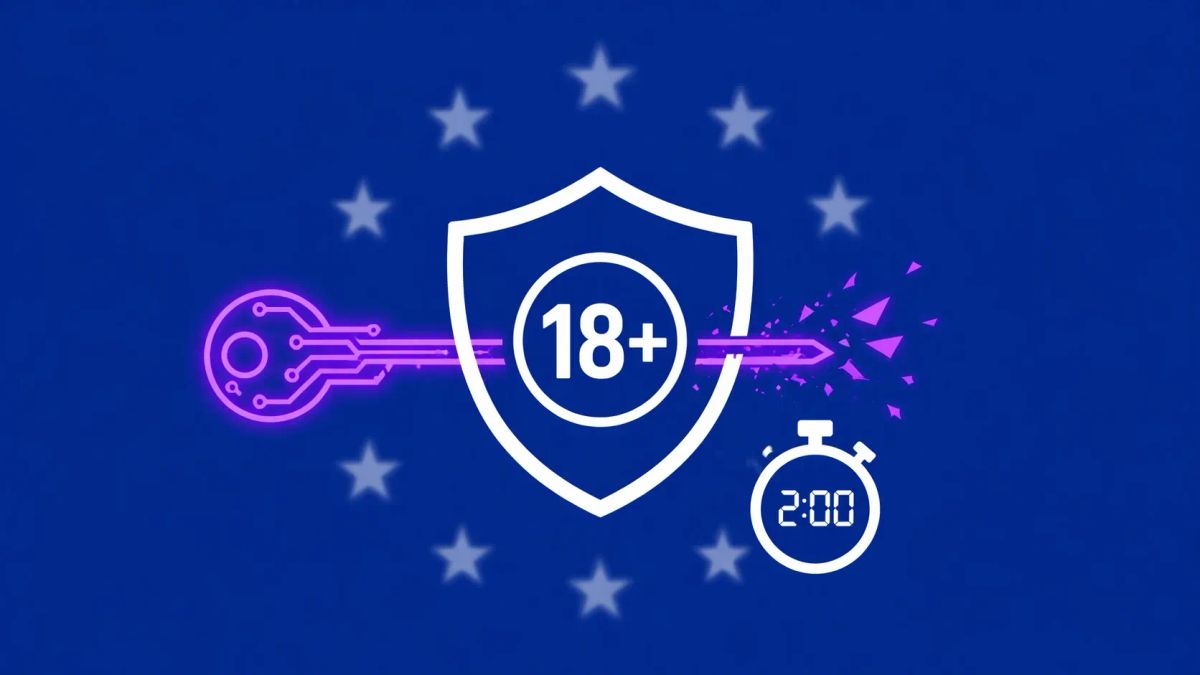
The European Commission’s flagship age-verification tool, touted as a secure solution for protecting minors online, has faced a disastrous rollout after independent researchers bypassed its core security features in under 120 seconds.
Brussels, Belgium — The European Union’s ambition to set a global standard for online safety has been met with a harsh technical reality. Within hours of the European Commission declaring its new age-verification application "ready" for use, security researchers and developers demonstrated that the software’s integrity could be completely compromised in approximately two minutes.
The failure is particularly notable because, as reported by Politico and Wired, the project’s GitHub repository had previously been flagged by contributors as unfit for production, with experts warning of fundamental architectural flaws long before the official launch.
Technical Snapshot: EU Age-Verification Failure
The Mechanism: Bypassing "Hardened" Identity
The app was designed to provide a privacy-preserving way for users to prove they are over 18 without sharing full identity documents with third-party websites. However, the implementation of its "Proof of Age" certificate was found to be dangerously fragile.
Based on technical dissections from Tech Policy Press and Hacker News, the exploit focuses on:
- Client-Side Vulnerabilities: The app relied heavily on local device checks rather than robust server-side attestation. Researchers were able to use standard debugging tools to "hook" into the app and force it to return a "Valid" status, regardless of the actual data provided.
- Certificate Forgery: Because the cryptographic signing process was poorly isolated, hackers successfully intercepted and replicated the tokens used to verify age to external platforms like Telegram and adult content sites.
- The "Two-Minute" Exploit: The speed of the hack — cited by Telegram founder Pavel Durov and corroborated by multiple independent researchers — suggests a total lack of basic anti-tampering or obfuscation measures that are standard in modern financial and identity apps.
Policy vs. Production
The European Commission has defended the app, suggesting that the version compromised was a "demo" or "testing" iteration. However, critics on Reddit and Privacy Guides pointed out that the Commission’s own public relations pushed the app as a finished, secure product. The incident has reignited a fierce debate over whether centralized government apps are a viable solution for age verification, or if they simply create a new, high-value target for identity theft and spoofing.
The CyberSignal Analysis
Signal 01 — The "Security by Policy" Trap
This incident is a definitive signal for vulnerabilities. It proves that political "readiness" and technical "readiness" are often in direct conflict. For B2B leaders, the EU app failure is a reminder that compliance certificates do not equal security. The signal is that third-party identity tools must be subjected to rigorous, independent penetration testing before being integrated into a corporate stack.
Signal 02 — The Death of Client-Side Trust
This is a high-fidelity signal for identity & access management (IAM). The fact that the app was bypassed in two minutes highlights the inherent risk of trusting a user's device to "tell the truth." The signal for 2026 is that all identity claims must be verified via hardware-backed attestation (like TPM or Secure Enclave) or server-side zero-knowledge proofs. If the logic lives on the client, it lives in the attacker's playground.
Signal 03 — Building Resilient Authentication
When government-mandated tools fail, the burden of verification falls back on the platforms. To learn how to build authentication systems that don't rely on fragile third-party apps, see our guide on what is account takeover (ATO): prevention & detection guide, which covers robust MFA and identity verification strategies.